In Bhimgad’s rainforests, I report ethnographically on the "voluntary" relocation of Talewadi, exposing the friction between state transactions and indigenous worldmaking. Through multispecies ethnography, I argue that engineered precarity manufactures an illusion of choice. Financial compensation cannot recover the coherent "taskscape" lost when dwelling is severed to satisfy conservation frontiers.
Full story on: https://solankarsaish.com/leaving-the-troubles-not-the-home
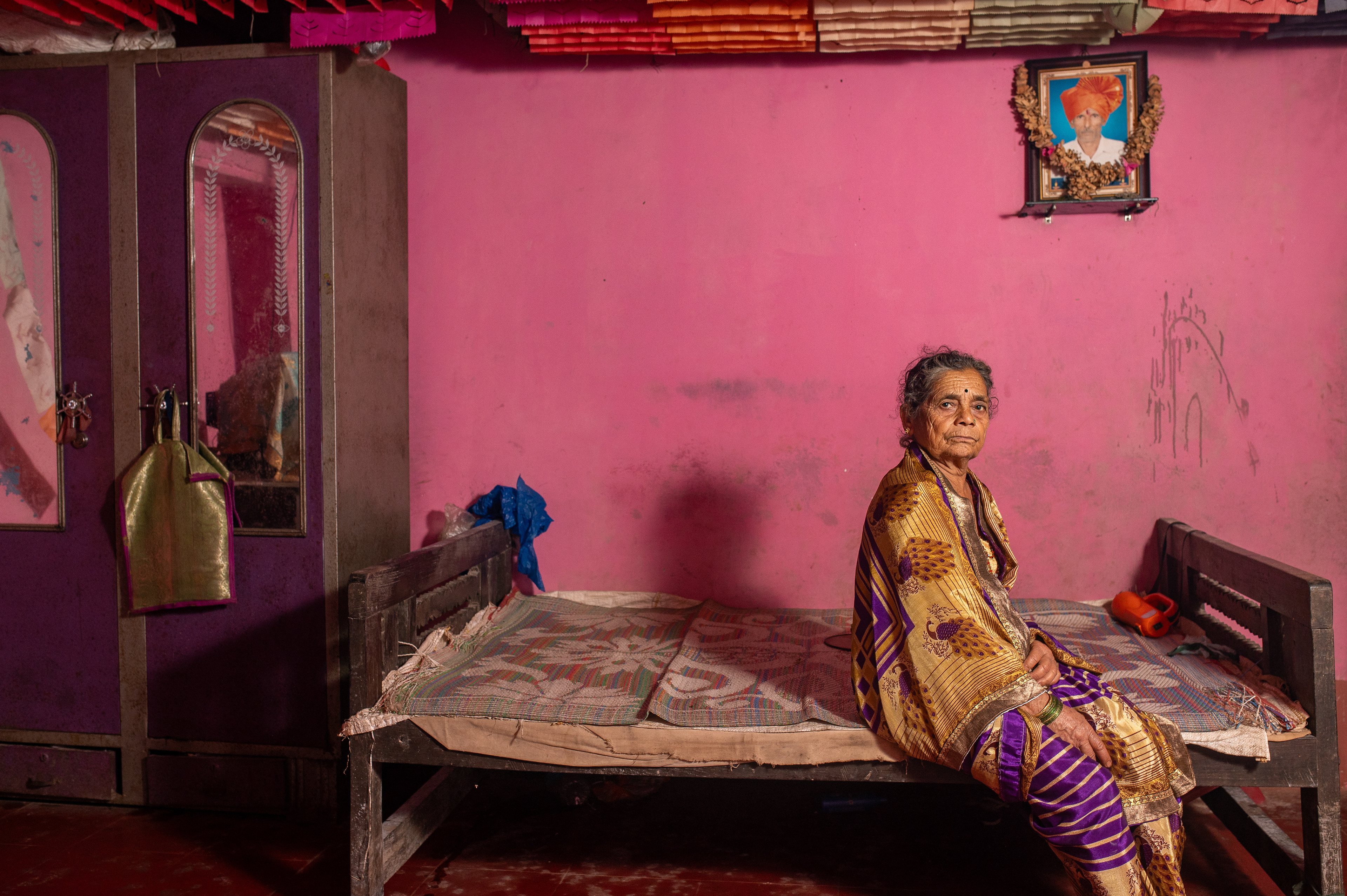
"Leaving the hardships, Not the home."
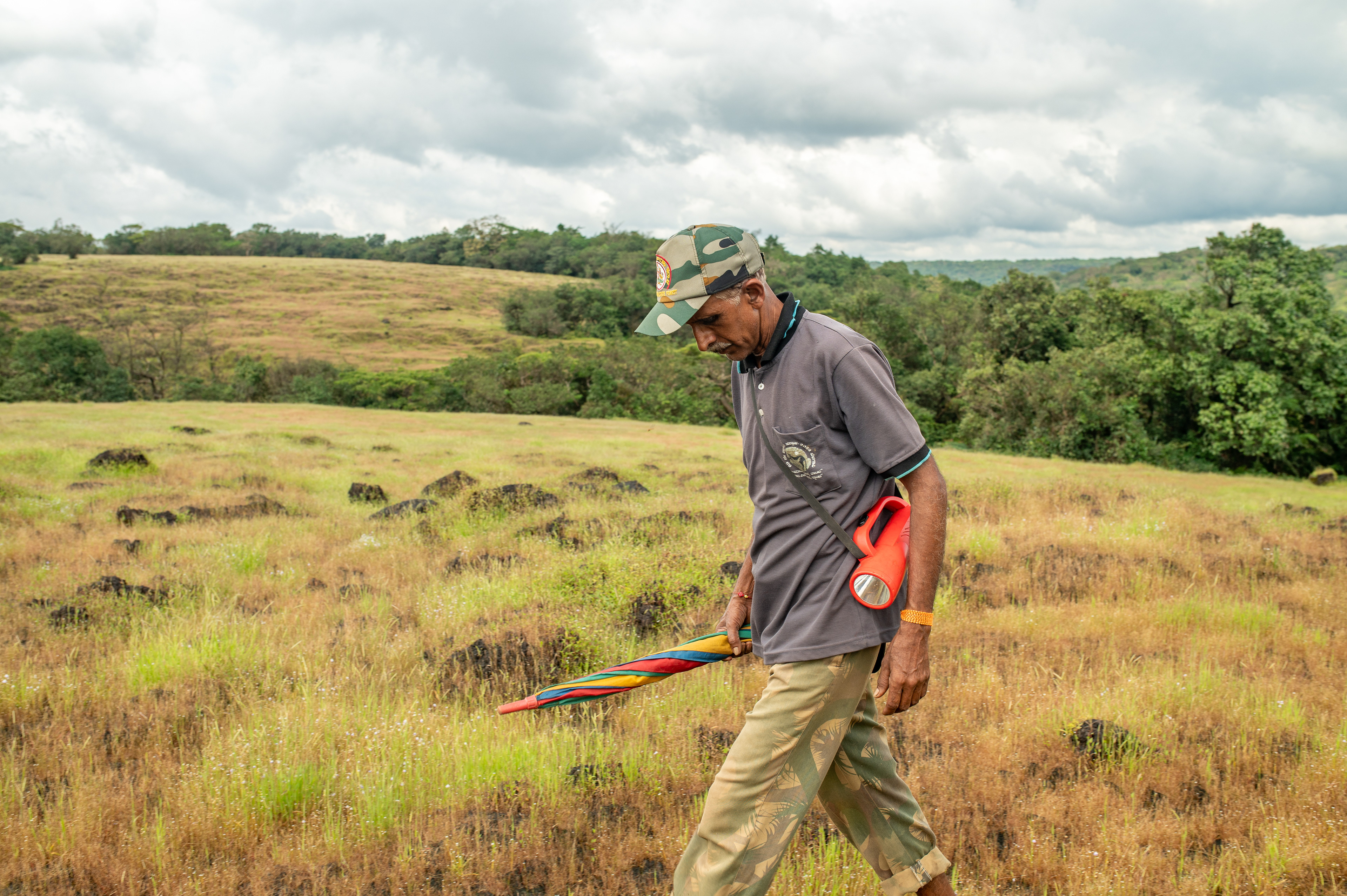
I woke up with a shiver from the cold early on a typically rainy morning in the rainforest. The howling wind added auditorily to my experience of feeling the chill. I woke up an hour earlier than I had planned and added another layer to my body. The antiquated structure of the Talewadi Anti-Poaching Camp (APC), where I was staying, was homely but clearly inadequately provisioned for a comfortable stay in the rainforest. I walked across the corridor of the twin-roomed APC building to the back door and stepped through it into a semi-outdoor space covered by a tin roof. A mud-polished floor kissed my bare feet with a shock of cold as I let out a cry. “Bhau, te bazu chi chappal ghala. Khup thanda ahe.” (Brother, wear the slippers next to you. It is very cold in here.) Santosh, the forest guard posted at this APC, called out to me as he boiled water over a clay stove at one end of this exposed room, which was covered on three sides by a half-wall. I obliged and walked over to sit next to him, hoping the heat from the stove would help a little. “Aaz khupach thandi ahe. Paus pan.” (It is too cold today. Rainy too.) I said to Santosh as I held my hands above the pot of boiling water. “Aaz nhave, bhau. Asach asta ikde hya mahinyan madhe.” (Not today, brother. This is how it is here during these months all the time.) he chuckled. “He ghya.” (Take this.) he offered me a glass of warm water. I nodded with gratitude and left to go to the front of the camp. I crossed Mohan, the other forest guard, and Achal, my friend and field partner, still asleep in bed, as I made my way to the front door.
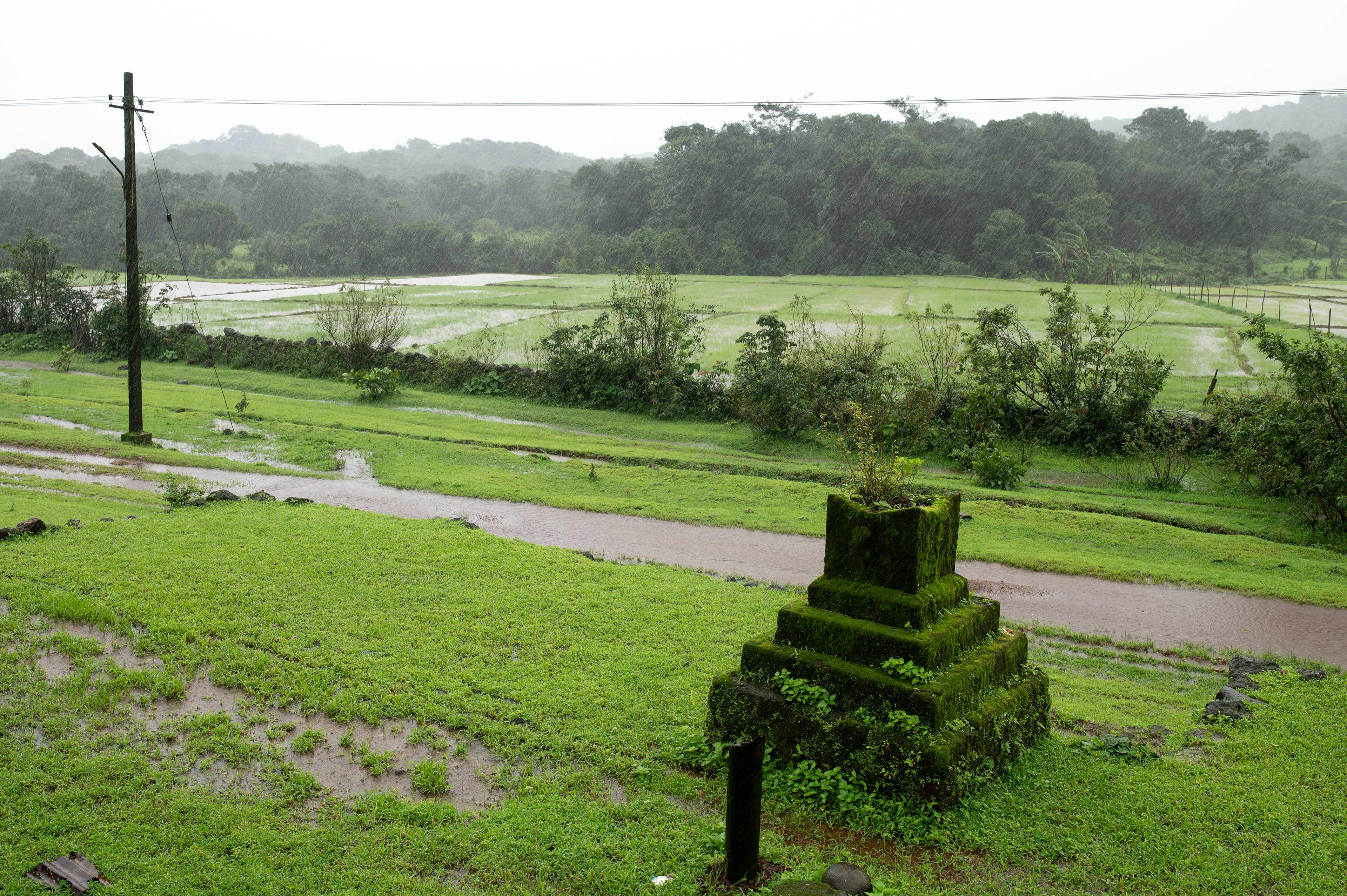
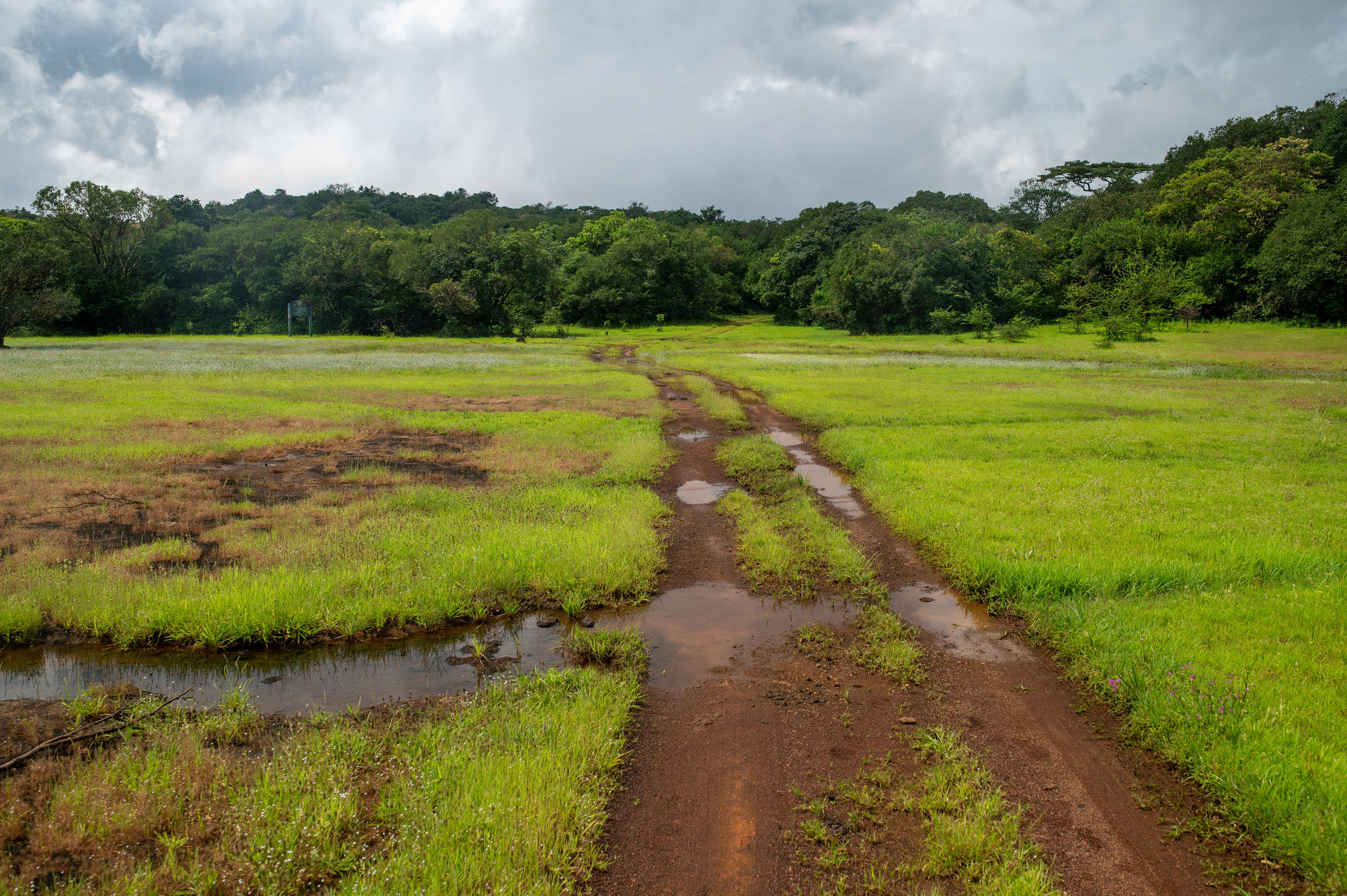
A lush, green landscape stood before me. This was my first visit to Bhimgad Wildlife Sanctuary in July, during the peak of the monsoon season. We had arrived after sunset the previous evening, so this was my first glimpse of the landscape. The ground was wet from the rain of the last two months. Puddles formed everywhere, and the air carried a hint of the pleasant petrichor of the Western Ghats’ red soil. An old but robust shed sat right across from the fence of the APC. Behind the shed, lay a short expanse of paddy fields. A vast expanse of tropical evergreen rainforest surrounded the shed, the fields, and the APC I was observing from. People described this place as one where the rain never stopped during the monsoon months. It varied in intensity, but at any given point in time, there would be a drizzle, at the very least. Parts of the sanctuary consistently receive over 10,000mm (400 in) of annual rainfall every year (Deccan Herald 2012). Being here reminded me of Tumbbad, a small fictional village of a similar size located in the Western Ghats of Maharashtra, not too far from here, in the cult-horror movie of the same name by Rahi Anil Barve & Anand Gandhi. The village in the film is described as having the wrath of the gods rain down upon the land in perpetuity. While the mythological element did not exist here, looking across at the shed in the rainforest evoked this cinematic imagery in my mind.
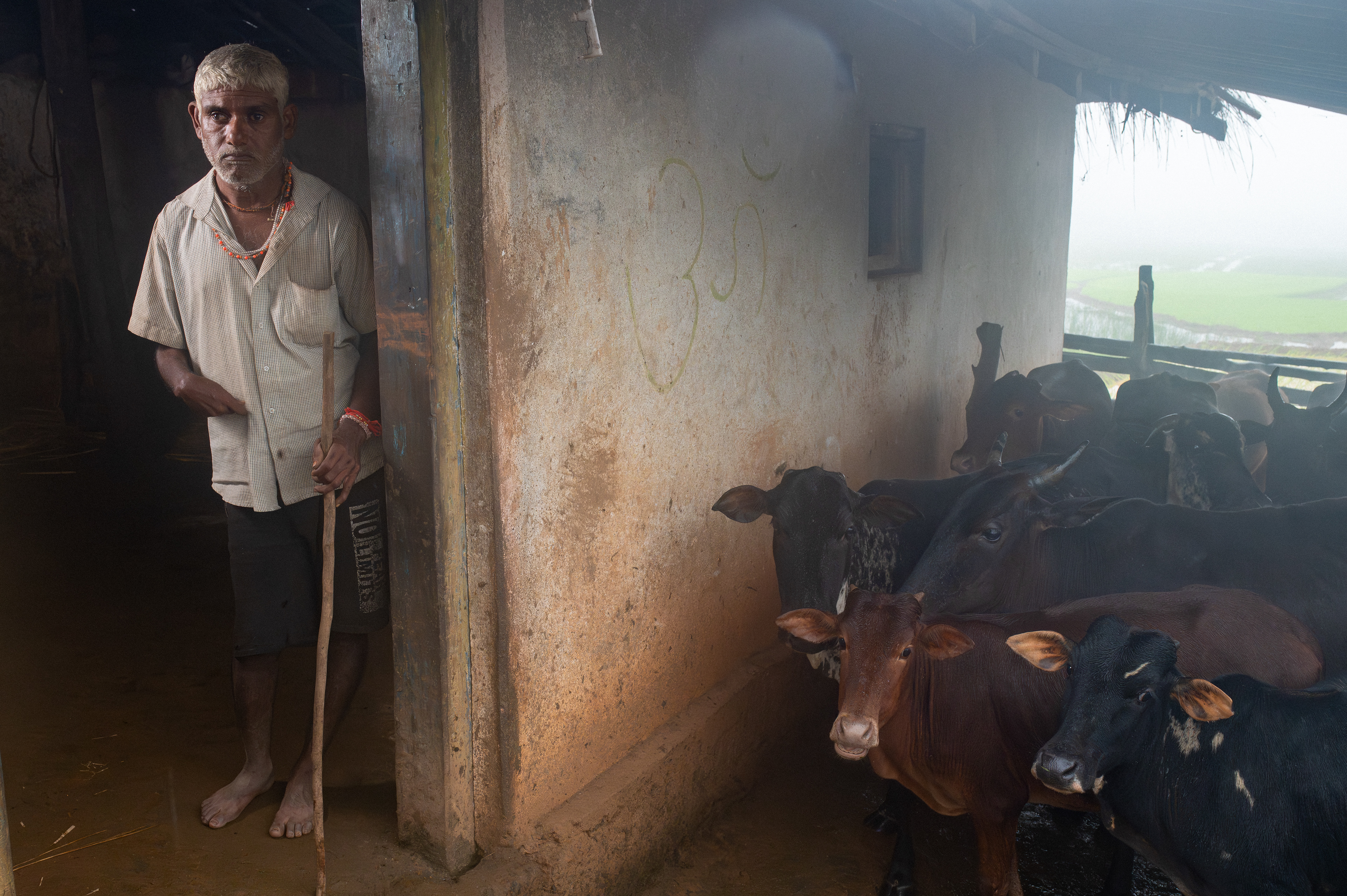
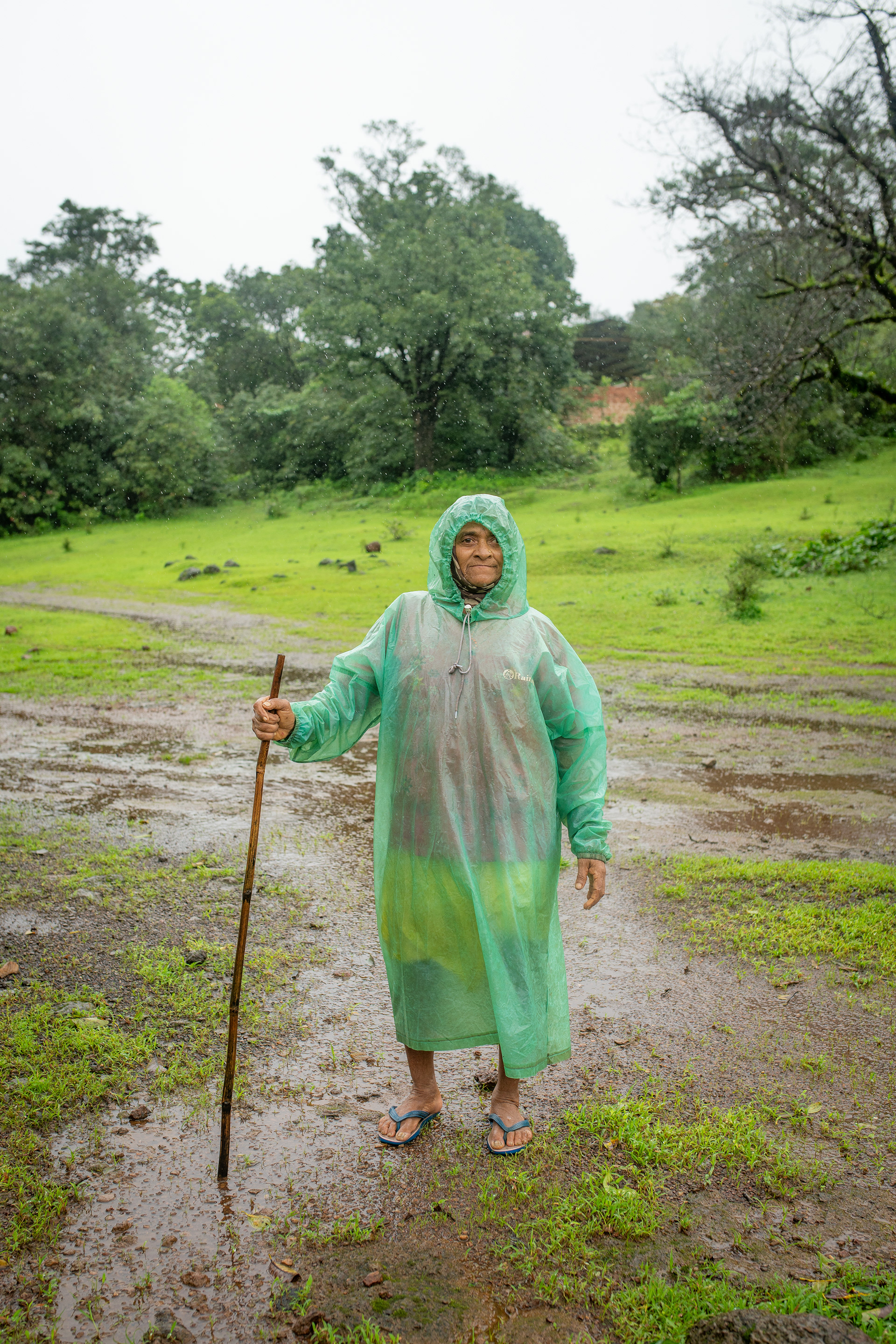
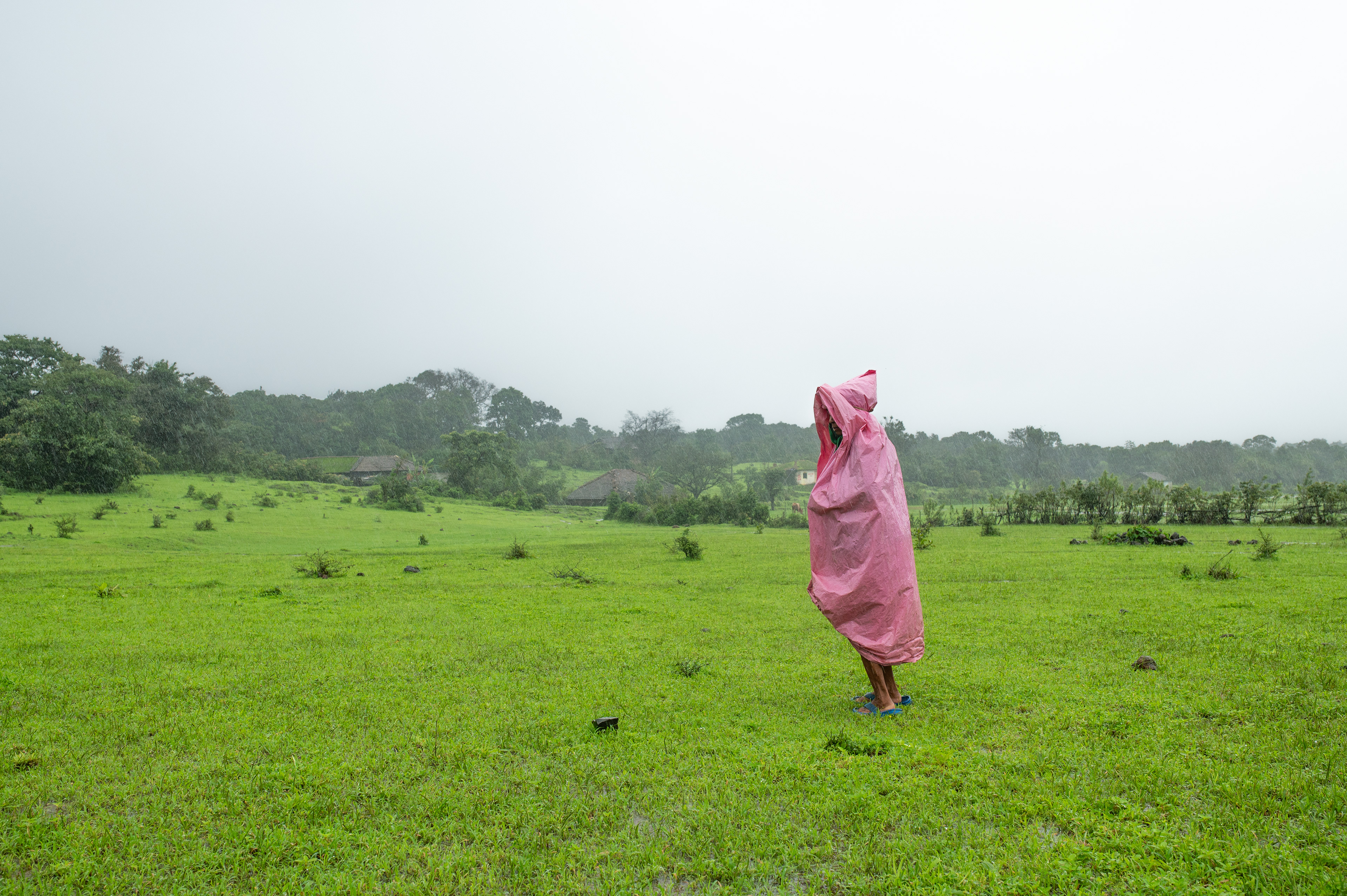
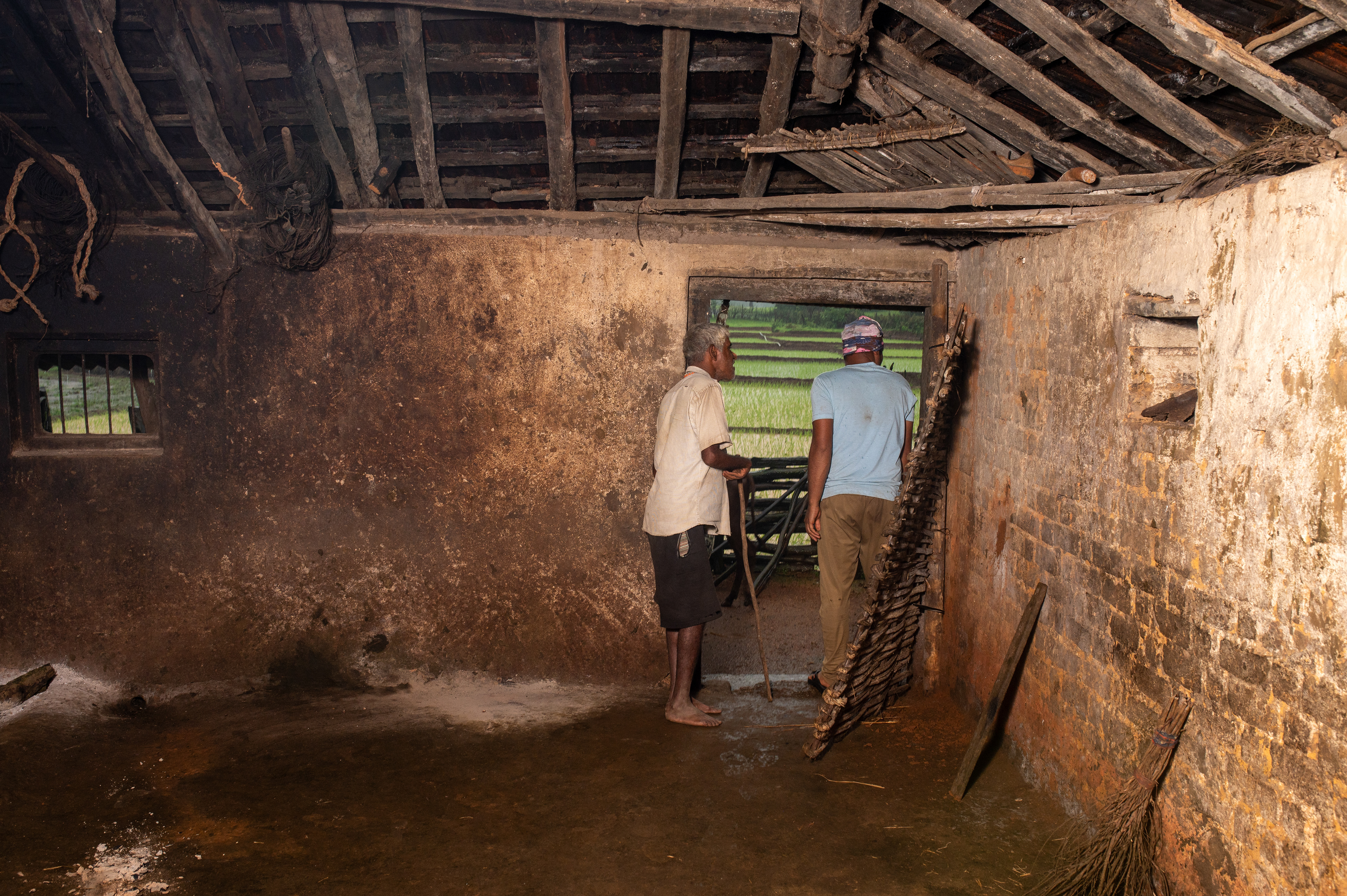
As I cleared my mind to be more present, I saw a figure moving, a person wearing a green poncho, arriving at the shed. Early in the morning, in the rain that would be classified as heavy in most places around the world but merely a drizzle for the residents, someone was already at work. I walked across to the shed and greeted the person. A wrinkled yet very warm face greeted me. This was Aarti Kaku, a sixty-year-old resident of Talewadi. The shed was her cow shed, where she housed her seven cows. She mentioned how she initially had eleven cows in this shed over the last couple of years, but four of them had been taken by Tigers and Leopards. She was out this morning to take the cows out to graze, as she does every day. Clearly, this was an ideal place for cows to graze. I didn’t think they’d ever run out of grass to eat. Aarti Kaku told me she had been doing this every single day of her life for decades, and it was a very integral part of who she is. Most curious about the rain, I asked her if she was at all fazed by the constant pouring down. “Savay zhaali ahe ata. Changla vatta,” (It has become a habit. The rain feels good.) she calmly answered. “Kasa pan, haa pawsala amcha ithla shevat cha.” (Anyway, this monsoon is our last one here.)
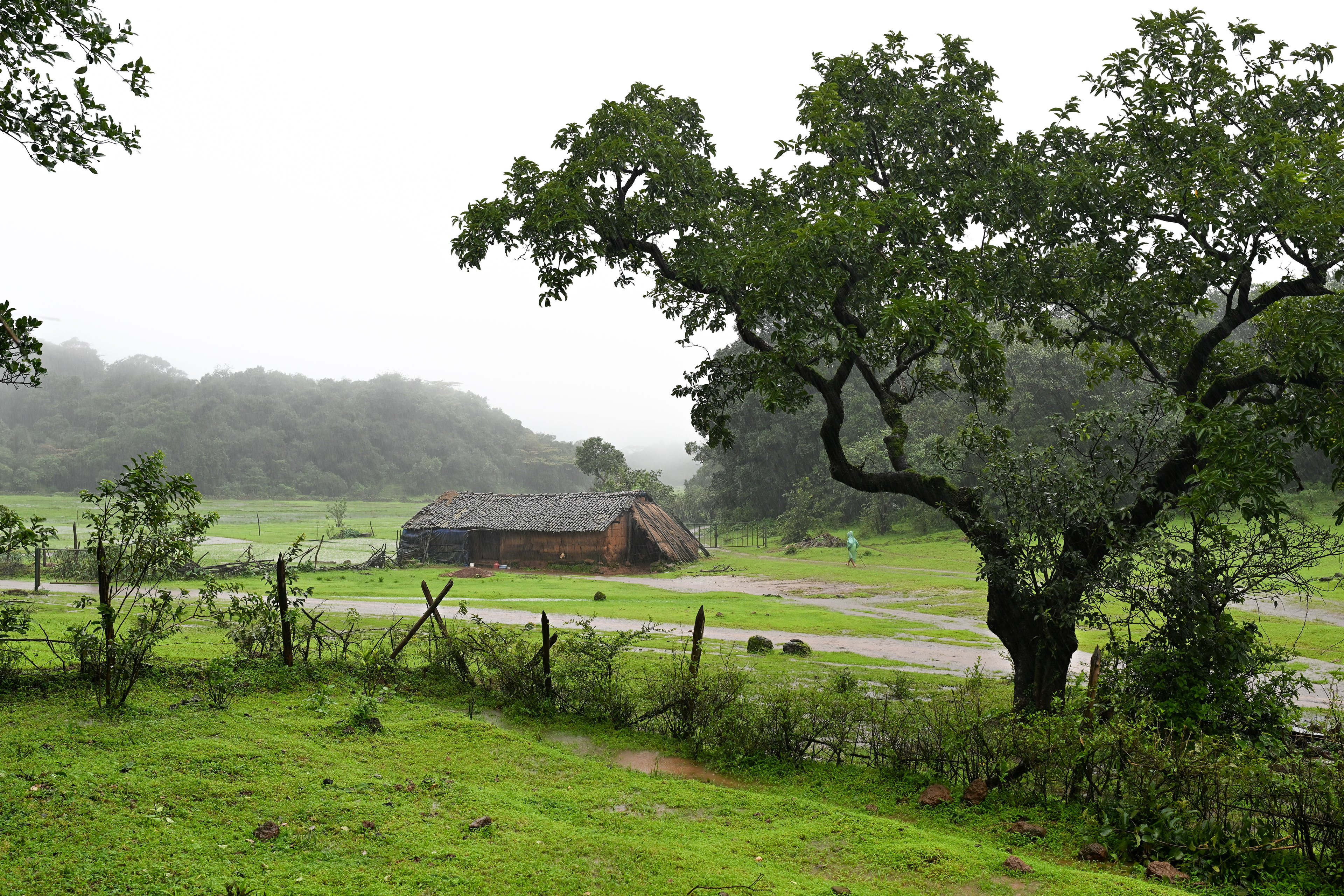
Aarti Kaku (in a green poncho) walks along her Cowshed, the paddy fields, and the rainforest.
My brief conversations with Santosh & Aarti Kaku served as an anchor for thinking about where I was and what point in history I was in. Achal and I were in Talewadi, one of the thirteen hamlets nestled within Bhimgad Wildlife Sanctuary in Belagavi District, Karnataka, in the Western Ghats of South India, also known as the Sahyadris. The thirteen villages have been in protracted negotiations regarding relocation outside the sanctuary with the forest department and the state government of Karnataka for just under two decades. In 2025, Talewadi became the first village to reach an agreement and initiate the relocation. We were here to speak with the villagers about this process as they reflected on the relocation. Villagers referred to life in Talewadi as a union of many lives and histories, human and non-human, and the place. Through the bear that ambushed a man multiple times, the snake that is venomous on specific days of the week, and Aarti Kaku’s fascination with big cats — stories I will expand on below — the villagers, through their engagement with the landscapes around them, made worlds.
Anthropologists have long explored how different cultures have distinct ways of seeing, knowing, and being in the world. Notably, early in the conversation was Frans Boaz, a proponent of cultural relativism, who argued that each culture had its own history and logic supporting its perception of the world. In his landmark book from 1911, The Mind of Primitive Man, Boaz draws from the studies of ethnology and quotes, "The data of ethnology prove that not only our knowledge but also our emotions are the result of the form of our social life and of the history of the people to whom we belong." Later in the twentieth century, Clifford Geertz became another influential scholar in the field, adding to this conversation. Geertz viewed culture as “webs of significance” that people spun for themselves and expressed through symbolic forms. “Man is an animal suspended in webs of significance he himself has spun, I take culture to be those webs, and the analysis of it to be therefore not an experimental science in search of law but an interpretive one in search of meaning,” he says in his influential 1973 book titled The Interpretation of Cultures. However, it wasn’t until 1978 that the term “worldmaking” was coined by the Philosopher Nelson Goodman in his book titled Ways of Worldmaking. Goodman argued that we as humans and as peoples create different versions of the world around us, which are not merely interpretations and metaphors of a static reality, but are themselves the realities that we inhabit. "There is no one way the world is. The world is not one way, but many," he says. Marilyn Strathern has employed the concept to examine social relationships, proposing that these worlds are not created by autonomous individuals but rather emerge through a complex web of relationships with one another.
Furthermore, Tim Ingold argues that humans do not construct these worlds solely through cognitive processes, but through active bodily engagement with their environments. In his collection of essays titled "The Perception of the Environment" (2000), he proposes a "dwelling perspective" that argues humans don't inhabit a pre-given world, nor do they simply impose culture on nature. Instead, the world is continually constituted through the skilled, practical activities of people moving and living within their environment. Placemaking, here, is the ongoing process of skillful, embodied engagement with the environment, creating a taskscape. My exploration of the people of Talewadi examines how the villages create places. The anecdotes I refer to in this paper describe the villagers of Talewadi's interactions with the rainforests surrounding them, providing a glimpse into how these worlds — and a home — are made in the jungles of Bhimgad. Although I expand substantially on these more-than-human worlds in Talewadi, the primary arguments of this paper revolve around displacement outside of these worlds. Specifically, I am interested in exploring what it means to be home, and subsequently, what it means to be displaced away from that home.
The relocation of Talewadi and the other villages within Bhimgad Wildlife Sanctuary is not an isolated event. In fact, it is the latest iteration of the state’s historical pattern of codifying and controlling its forest resources at the cost of its Indigenous and pastoral citizens. The relocation process in the region is governed by the National Tiger Conservation Authority (NTCA), which sets the legal framework for the entire process under the Centrally Sponsored Scheme of Project Tiger. The NTCA, founded in 2006, is also a recent addition to India’s legacy of conservation models. Madhav Gadgil & Ramchandra Guha’s 1993 book, This Fissured Land: An Ecological History of India, provides a deep historical and political context for India’s legacy of conservation and displacement. The book demonstrates how this displacement is a process that began in the colonial era and continued into the post-colonial age in the country, arguing that India's ecological crisis stems from the displacement of traditional, sustainable resource management systems. Guha (2017) references the “Yellowstone Model” of conservation used in the United States, and how India followed a similar model of “Fortress Conservation,” essentially pushing forest-dwelling communities out of their traditional homelands to aid the new, exclusionary ideal of ecosystem conservation. These models have enabled the state to view the peoples in question merely as a cost to push other agendas ahead, ecological and otherwise.
Scholars have examined various aspects of displacement and migration across multiple disciplines. From the materiality of dispossession to the memories of place, relocation speaks not only to the lived experiences of individuals and communities but also to the power dynamics involved. In her book titled Precarious Life: The Powers of Mourning & Violence, Judith Butler (2004) addresses how certain lives, often the marginalized, are rendered "ungrievable" or less valuable by political structures. This directly relates to why the worlds and places made materially and otherwise by the residents of Talewadi and the other villages within Bhimgad are overlooked by the concerned institutions in favor of tiger conservation.
The relocation of the Bhimgad villages presents an interesting case in the state’s extensive history of driving such displacements and of displacements elsewhere in the world, primarily due to the “voluntary relocation” label. Numerous factors, or ‘Hardships’ that the title of this essay mentions, pushed the people of Talewadi to consider and eventually accept the state’s proposal to move out of their homeland. These include human-wildlife conflict, tumultuous weather, and the lack of a stable livelihood. Following my ethnographic dive in the village of Talewadi and the wildlife sanctuary of Bhimgad, a few questions arise: Is the relocation of the people of Talewadi actually voluntary? Or is it a case of state hegemony and coercion? The Talewadi case is more nuanced and demands an examination that goes beyond a simple yes or no to the questions raised. I argue that the “voluntary relocation” of Talewadi is a result of a myriad of factors, including human, non-human, and more-than-human elements, such as state legacies of displacement and governing livelihoods, all of which come together to shape the worlds in Talewadi and subsequently displace the villagers. The relocation is arguably an induced displacement fueled by the illusion of choice, which is not born out of genuine preference but rather a result of coercion due to the impossibility of sustaining livelihoods in the protected areas. I also argue that the villagers' centuries-long placemaking and worldmaking in Talewadi cannot be adequately compensated through financial means. The true cost is the loss of a coherent worldmaking system tied to the forest ecosystem.
In this essay, I attempt to demonstrate the worlds made by the residents of Talewadi through their interactions with the tigers and leopards that prey on their cattle, the bears that attack humans, the cows they revere and affectionately care for, and the forest department that employs some of the villagers, among many others. I collect the villagers’ perspectives on what a home means to them, and present this essay as a record of this place they called home for generations, in times of precarity, as they prepare to move.
A Note on Place & Method
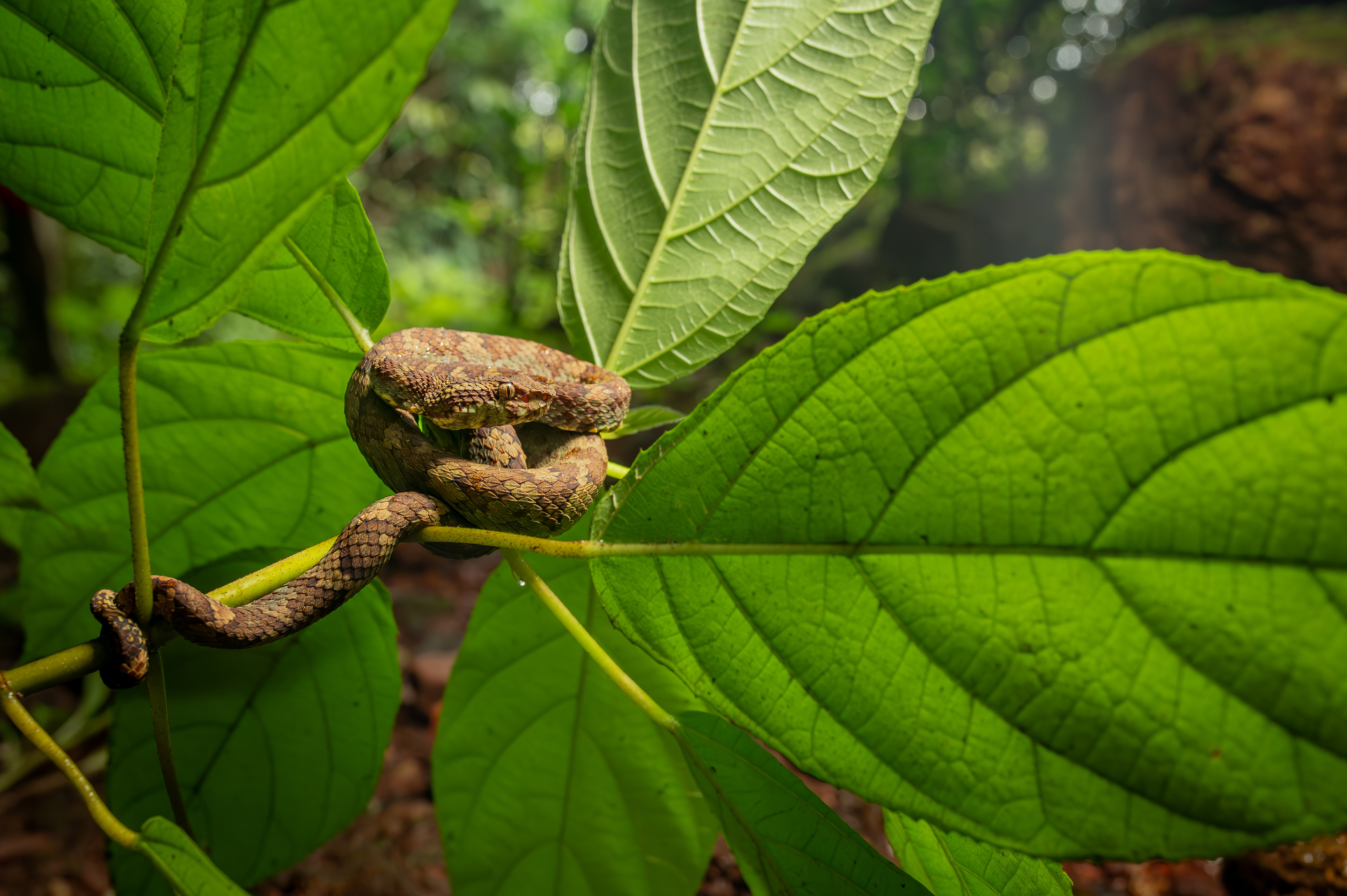
An hour-long drive into the heart of the thick rainforests of the Western Ghats from Bhimgad Nature Camp takes you through thick evergreen vegetation and the occasional shola grasslands. During the monsoons, the tyres of the 4x4 struggle, and getting stuck on the route must always be taken into account. Also, during this time of the year, the short bridge across the revered river Mhadayi is submerged. Mhadayi takes over the bridge in Bhimgad on her way to Mhadayi wildlife sanctuary in Goa, before draining into the Arabian Sea. Along the river, kingfishers hunt, keelbacks bask in attempts to catch whatever scarce sunlight there might be available, and gliding frogs lay eggs in pouches on leaves overhanging the flow of the river. On this drive, you see trogons and bulbuls, the occasional family of Chital running across the grasslands through the trees, and vine snakes & vipers perch on thin branches, waiting to ambush unsuspecting prey. If you’re lucky, you might catch a glimpse of a big cat. If you’re luckier even, a pack of Dholes. A visual overload of lush green and bright red soil, the sounds of constant rain and flowing water dominate the soundscape, with the frequent calls of over a hundred species of birds dominating the sensory experience.
At the end of the hour-long drive, you arrive at a small expanse of the lush, wet grasslands surrounded by the rainforest, adjacent to the famed Barapede Caves, home to the enigmatic Wroughton’s free-tailed bat. A collection of around two dozen houses in multiple clusters, Talewadi is a small, quaint village. The houses themselves are made of bricks and mud, covered with clay tiles to form a roof. These clusters of houses are surrounded by paddy fields, where you see the families usually work during the day. The roads are unpaved and always wet. In the physical and cosmological center of the village is a Hanuman temple. The families take turns weekly to perform their duties, maintaining the temple and making offerings to Lord Hanuman. A small solar farm catches whatever sunlight can be caught in the monsoons to generate electricity for the village, as there is no other source of energy that can be drawn inside the rainforest. Besides this, there are fewer than a dozen streetlights lined across the village that self-activate at night. Cowsheds like Aarti Kaku’s lay scattered around. Some houses have cowsheds attached to their living spaces. In between all these elements, lie what Achal and I named ‘Dummy Houses,’ an interesting phenomenon and an important analytical tool in understanding the politics of the village that I will return to below in the essay. An abandoned school building stands at one corner of the village, its walls riddled with water leaks, and the surrounding plants encroaching upon it. In the village, you see adults, elders, and young children. No adolescents or teenagers.
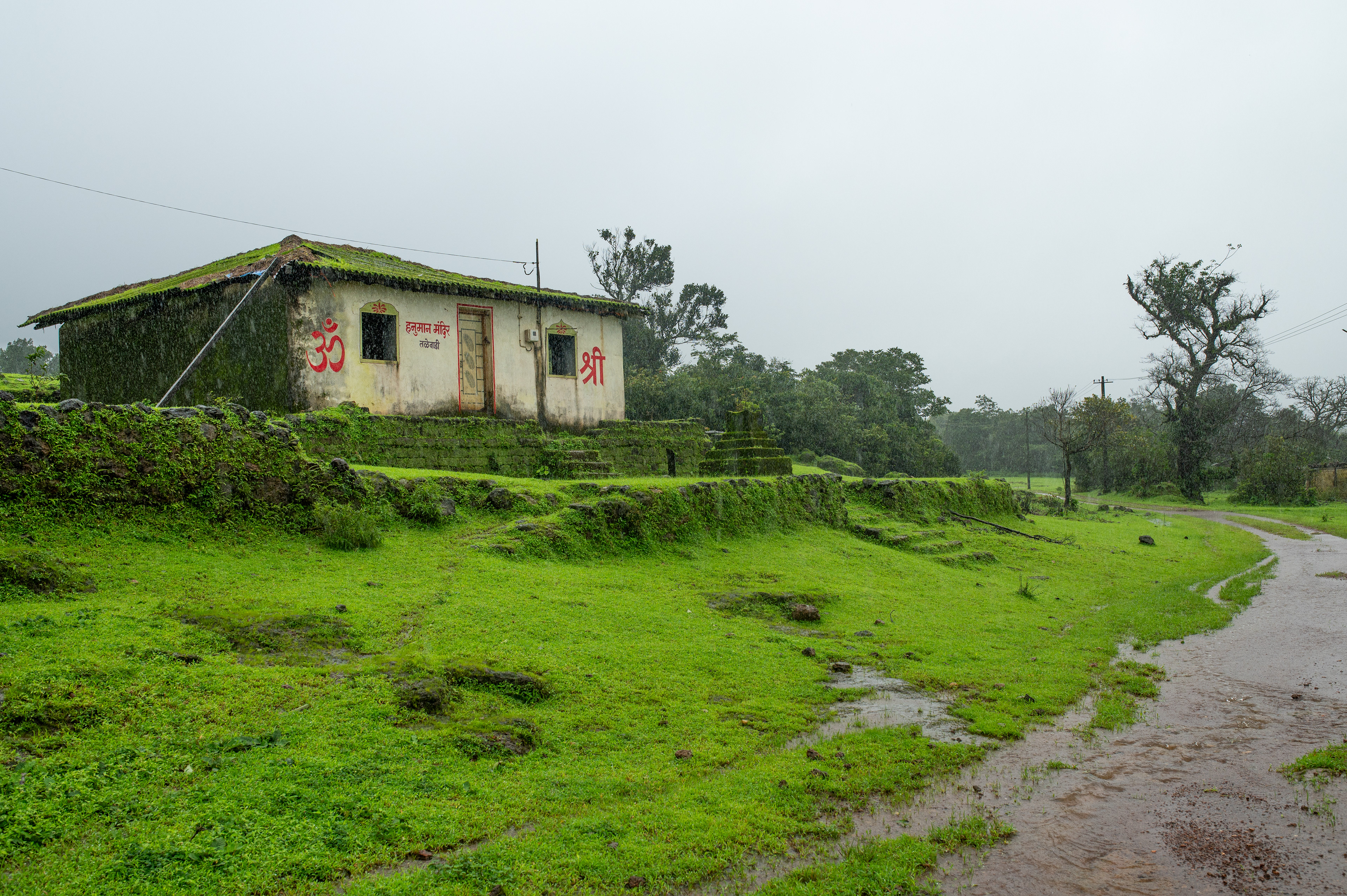
The Hanuman Temple in Talewadi Village.
The houses are lined with mud on the inside, with wooden cots covered with bamboo mats in most rooms, if not all. Some houses have plastic chairs in these rooms. Each house, however, has a small temple. This room is adorned with photographs of Hindu deities on the walls, along with other religious elements, reflecting the villagers’ ethnic identities. The people of Talewadi are Dhangars — a prominent nomadic and semi-nomadic community in India, predominantly found in Maharashtra, as well as in parts of Karnataka, Goa, and Madhya Pradesh. Their traditional livelihood revolves around pastoralism, specifically herding sheep and goats. The Dhangars are primarily Hindu, and that is reflected in Talewadi’s material layout. I come from a Dhangar family myself, and this part of my identity and positionality helped break the ice with the residents in Talewadi.
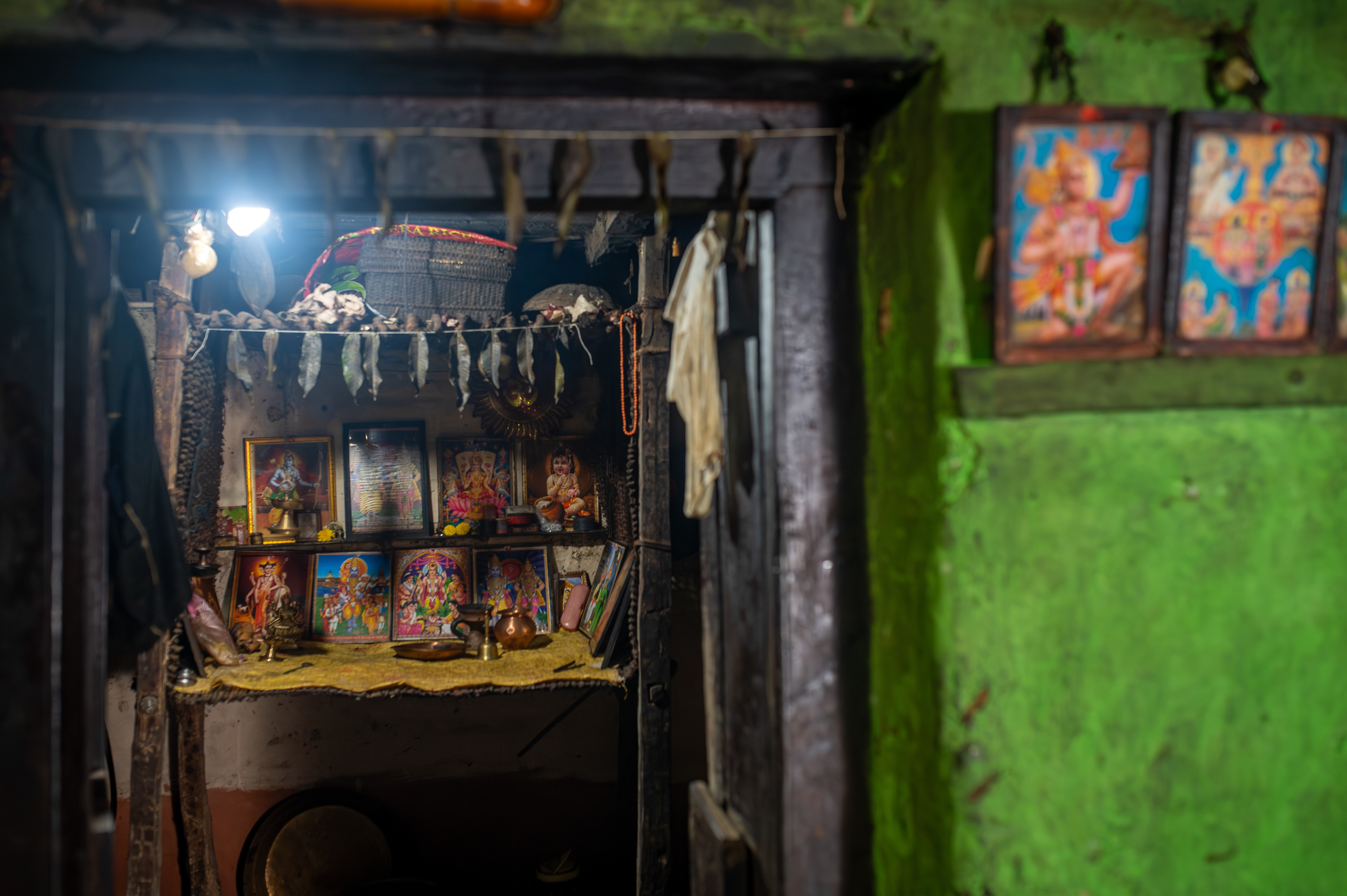
The temple inside Krishna Mama’s house, lined with photographs of Hindu Deities. The wall outside is also lined with photographs of other deities.
As pastoralist nomads, the Dhangars moved around a fair bit across peninsular India. Krishna Mama, a tall and lean man in his early sixties, told us that his great-grandfather came to Talewadi while moving with their livestock. They really liked this location in the middle of the rainforest and decided to stay. They felt at home, we were told. Aarti Kaku, similarly, had mentioned that while she cannot tell us exactly how long the village of Talewadi has existed, she felt like the village has existed “kayam cha” (in perpetuity). She added that she knows with conviction that she can trace back at least three generations of her husband’s family in Talewadi. Indeed, most of what we know about Talewadi and the other villages in Bhimgad is through stories embedded in generational oral histories, as well as the ecological and material worlds they inhabit today.
In exploring the concept of home, how places and worlds are made, and the history of this relocation, I use the lives and life histories of the villagers I interacted with as an ethnographic tool to understand the dynamic interplay between identity, memory, and the constant re-creation of 'home' in the face of displacement. This methodological anchor allows me to move in a decolonial direction, as my friends in the village drive the direction of my analysis, and thus, the direction of this ethnography. For my exploration of the interactions between the villages and state machinery, I spoke with residents of Talewadi, as well as officers in the Forest Department, to understand the nature of the negotiations that took place between them.
It is important for me to acknowledge that getting access to Talewadi and its residents was a challenging task. The wildlife sanctuary, as a protected area, does not permit unauthorized individuals without affiliation to the thirteen hamlets or the forest department to enter its boundaries. As such, researchers must undergo a lengthy bureaucratic process to gain access. It is essential to recognize that a formal pipeline does not exist for obtaining permits to conduct ethnographic research. This also serves as a testament to how the people are viewed by the state, as it is not considered necessary to host ethnographic explorations.
Achal and I were able to gain access to Talewadi, permitted to travel inside in an official vehicle, live there, interact with the villagers, and carry out our objectives after a six-month period of radio silence following our initial request for access. Following this, we were left with limited time to complete our work before we had to move away. The project involved interviews with villagers and participant observation in the paddy fields, as we had conversations with them about the themes I was interested in from an anthropological perspective. I wasn’t able to spend extended periods of time in the village, and thus had to rely on recorded interviews, a method I largely avoid in my work. Additionally, this exploration was an exercise in documentation: we made portraits of the villagers as we spoke to them, and videographed the interviews. Other delicate moments of daily life were also photographed, following the documentary photography tradition.
It would be remiss of me not to acknowledge that the work done was quick and did not accord the delicate, slow time that a full ethnography of the people of Talewadi deserves, due to the above-mentioned constraints. However, I believe it is still important to put effort into documenting these precarious times in the villages of the sanctuary, as well as pivotal moments in the lives of the villagers and their connections to their homelands.
As such, I present this body of work as a counter-narrative to the perception of residents in these forest-dwelling communities as the human cost of the state's conservation priorities; a counter to the “ungrievable” peoples perception in the eyes of the state, as Butler calls it. The photographs made as part of this exploration serve as a visual record of the people’s lives at this specific moment, as they create worlds and places, prepare to leave their homes, and build such worlds and spaces elsewhere. Let us now proceed to understand exactly how the residents of Talewadi make worlds and places, thus making a home.
“Shevti Ghar te Gharach” (At the end of the day, home is home)
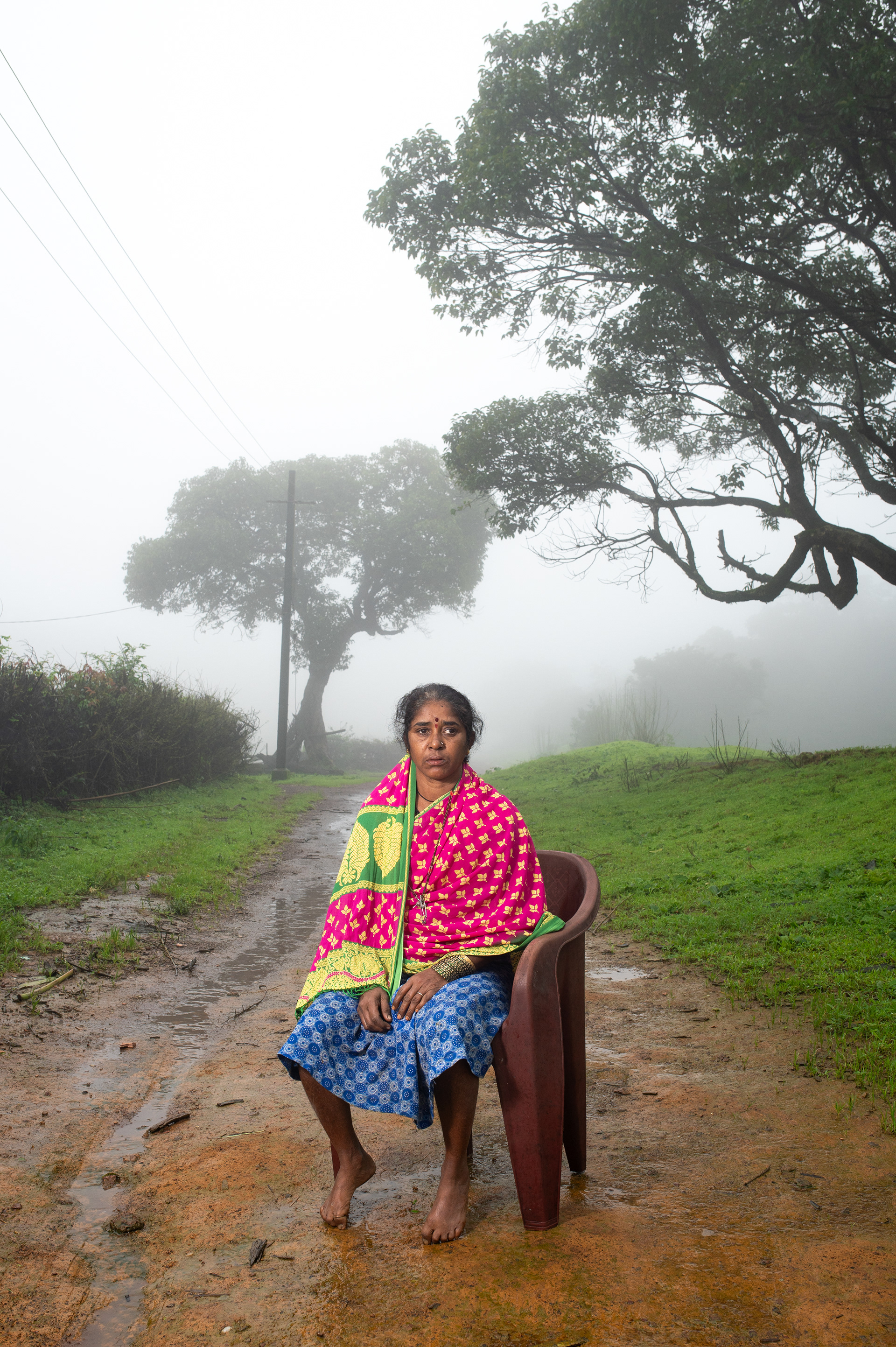
Aarti Kaku served us tea as we sat down in her house to speak with her, with the camera rolling. She draped her best saree, a golden and violet fabric with a peacock print, to look her best in front of the camera. She sat down on the cot right under the photograph of her late husband on the bright pink wall. “Me Talewadi la lagna nantar aale, chaalis varsha zhaale. Chaalis kay, saat bhi zhaale astil!” (I came to Talewadi right after I got married. It has been forty years. Forget forty, it seems like it could’ve been sixty, even!) Aarti Kaku reflected back on her time in Talewadi and in Bhimgad. She came to Talewadi after her marriage from Mendil, one of the other twelve hamlets in the sanctuary. Reflecting on her time in the village, she shares her daily schedule with me. She wakes up, sweeps, freshens up, and makes tea. After having tea, she prepares to head out to the cowshed and the fields. Before she leaves, she makes it a point to create a rangoli right outside her door, as her way of staying in touch with God, using the stencils that she very enthusiastically showed us when I asked her more about how she enjoys the art. She then goes out to take the cattle out to graze and milk them. After that, she returns home and cooks. She lived alone. Her husband passed away close to a decade ago, and her son and daughter both live away in Goa with families of their own. She is still close to them, but prefers to live in Talewadi, where she can be near the memories of her husband.
She told me that she held out for a long time. She was one of the last people in the village to agree to the relocation, understanding her resistance was futile by the end of it. Earlier, when I had spoken with her for the first time the previous day, she had mentioned that people no longer wanted to live off the land, which is why they wanted to leave. She, however, was content with life here and did not want to leave, holding on to her memories and sense of connection. Here, she made her home —and her world— by her daily acts. Creating a rangoli every day, engaging with her cows, and guiding them to graze, she enacts a Taskscape, becoming part of a complex, biodiverse ecosystem. Compelled by my interests as an anthropologist, I sought to understand how this ecosystem interacts with her to participate in this process of worldmaking.
Kaku told me that, beyond all the hardships life in the rainforest brings, she absolutely loves being surrounded by nature. She specifically speaks of the water and the air, praising their cleanliness and the sense of life they evoke in her. She mentioned being able to go out for a walk in the vast jungles. She refers to the ‘freeness’ and ‘openness’ of the outdoors here. “Bahirchya thikani gela tar asla moklapan kuthe pan nahi milnar.” (If you go elsewhere, you won’t get this feeling of openness.) she added. “Pakshi pan khup ahet ikde. Mala khup avadtat.” (There’s also a lot of birds here. I like them a lot.) When asked about the larger animals, such as the big cats, her immediate reaction was to mention how the tigers and leopards take her cows. I asked her how she felt about these big cats taking her cattle, and she responded by saying that it is a part of life. She didn’t expand any further, but had an appreciation for the nuances of life in her tone. This reminded me of what an interlocutor told Radhika Govindrajan (2018) about her dog being taken by a leopard in her multispecies ethnography from Kumaon: “A dog’s death means life for them. Every time I feel sad, I think “this is their relationship and who I am to break it?” Furthermore, Aarti Kaku described sighting the charismatic megafauna as a thrilling experience. She told me how, growing up, she and her friends would sometimes spot tigers and leopards in the distance and marvel at the charisma of these creatures that share their homeland with them.
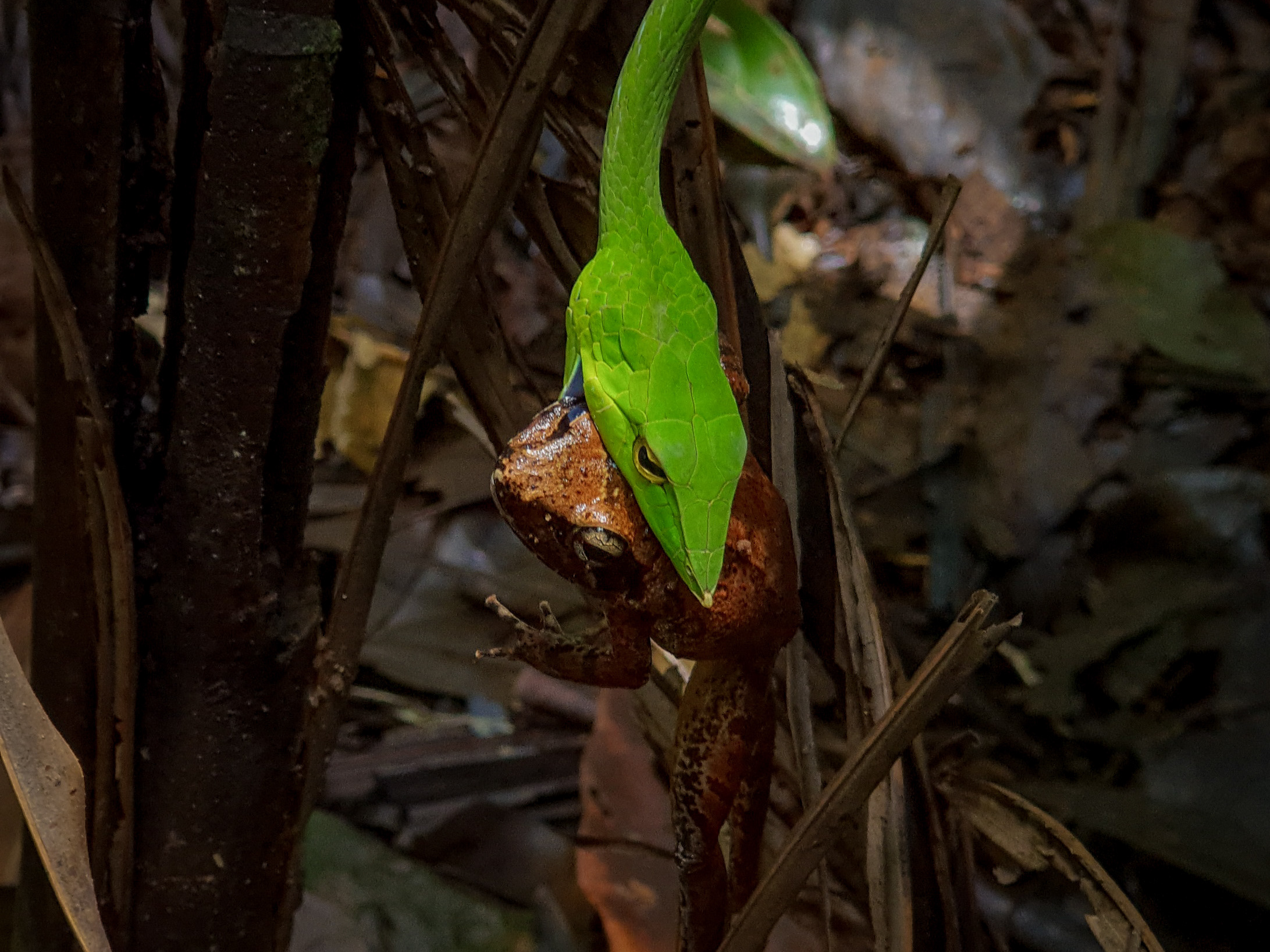
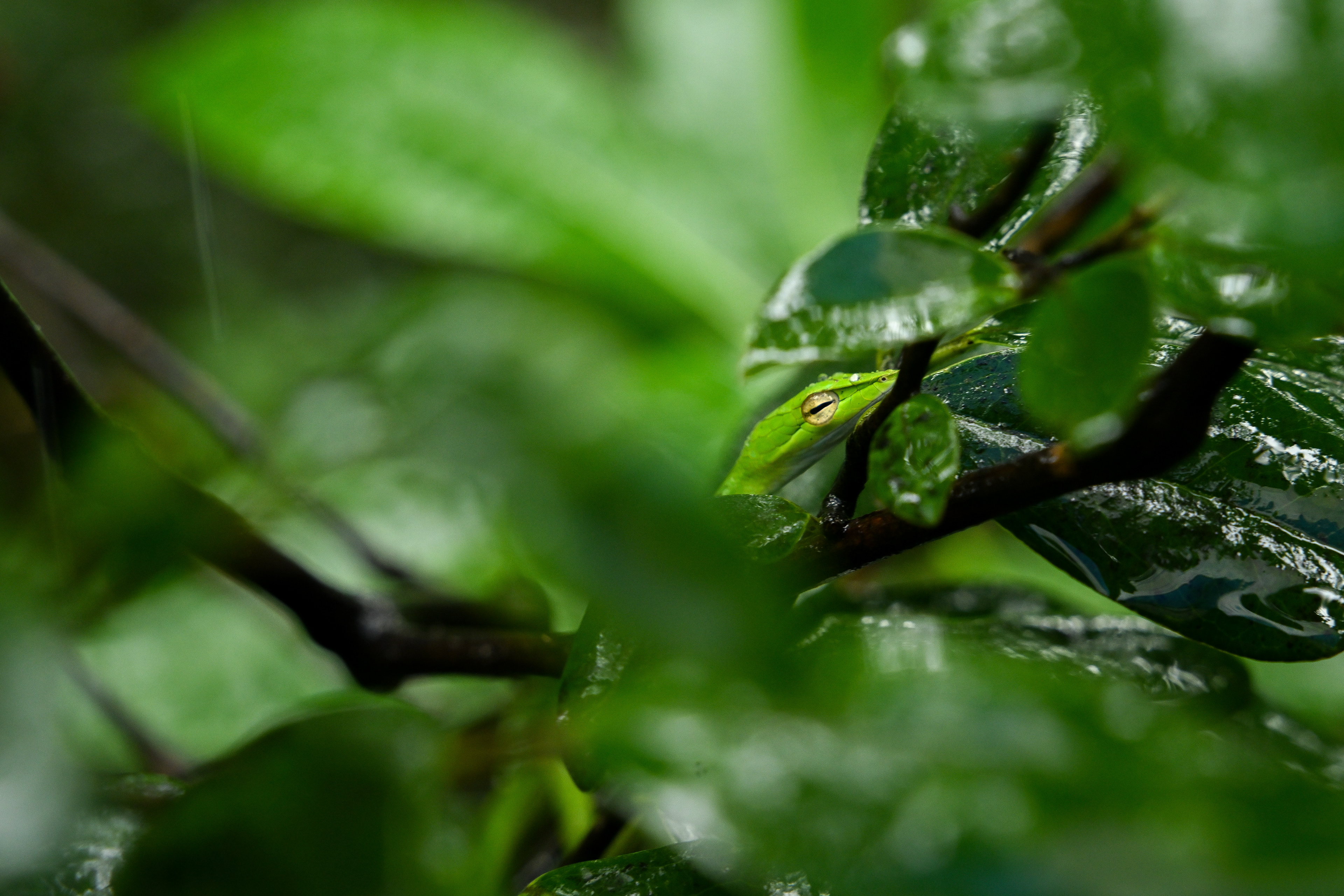
Wildlife around Talewadi occupies not only the physical spaces, but also the ontological worlds and the imaginations of all villagers. My eyes were opened to these imaginations and ontologies during a previous visit we had made to the village for a different purpose during the late monsoons of 2024. Travelling with a forest department contingent, we came across a green vine snake, or Hiriyata as the locals call it, perched on a vine. Achal got out of the vehicle and slowly crept closer to the snake, as Krishna Mama stopped him. “Aaz budhwar ahe,” (Today is Wednesday) he said, “Aaz ha visheri asto.” (This snake is venomous today.) I was surprised at what I heard. The locals believe that the green vine snake is venomous on Wednesdays and Thursdays. Biologically, the venom of the green vine snake is mildly venomous, meaning it contains rear-fanged venom that is potent enough to kill its prey, but not harm humans (Kalki & Weiss 2020). The villagers’ belief, then, although not rooted in ecological or evolutionary truth, is part of the world they’ve made. The villagers tell me that they are more mindful of walking around the jungles on these specific days of the week. In these ways, the worlds made by the snake and the people manifest materially in the lives of the people. Stories such as this have been passed down through generations in Talewadi and the surrounding villages, becoming an integral part of the abstraction of home and place here.
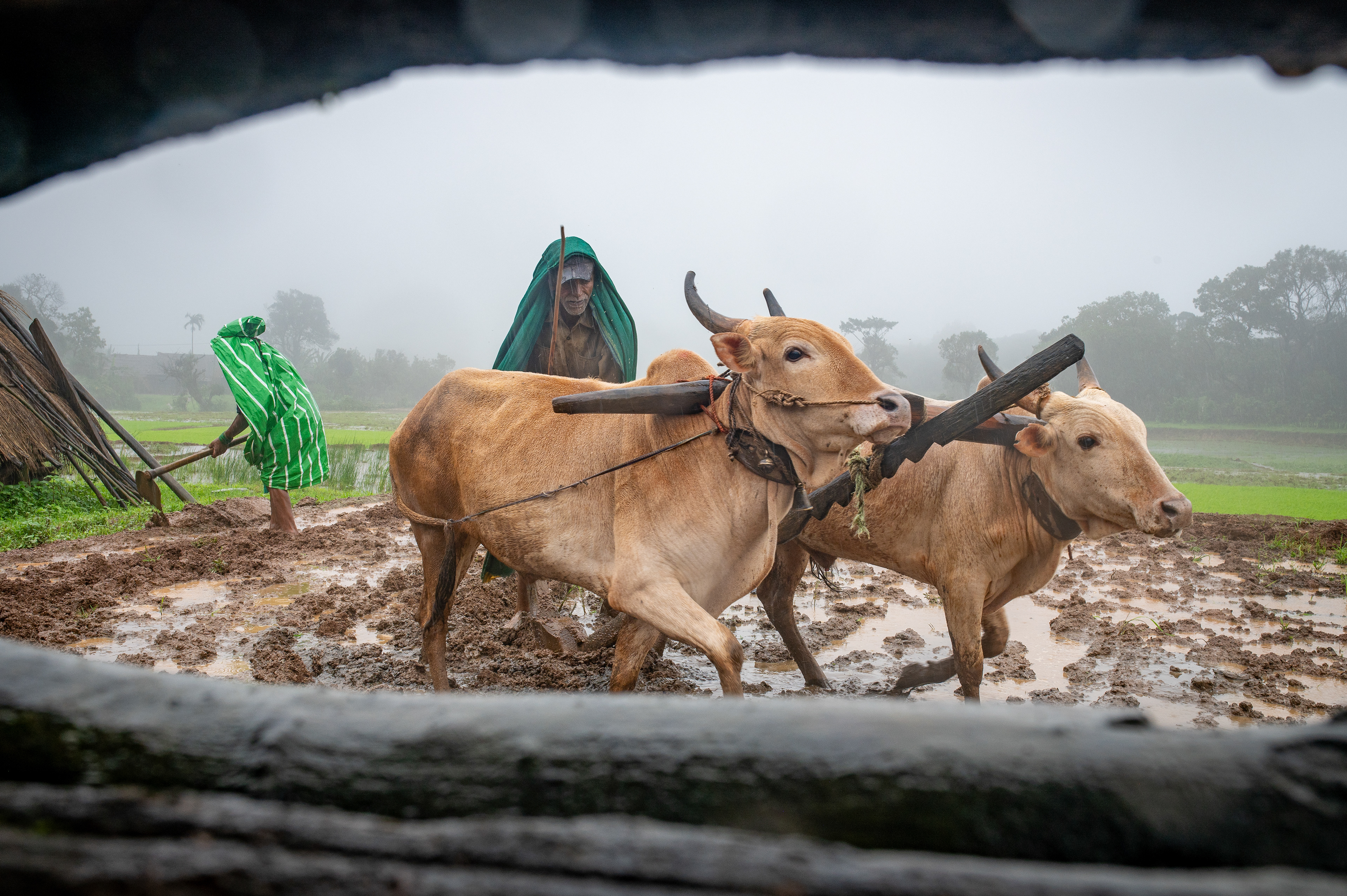
In exploring what home means further, we decided to take a short walk down to the paddy fields. Farming paddy for subsistence is an undisputable part of people’s daily lives here, serving as the primary source of carbs in the villagers’ diets. In many ways, growing rice in Talewadi until a decade ago could be viewed as a Total Social Phenomenon, borrowed from Marcel Mauss’ famous 1925 essay, which Joanna Davidson (2016) refers to in her ethnography of the Jola peoples in Guinea-Bissau, Sacred Rice. Davidson argues that for the Jola, rice is not just a food source, but a phenomenon that is completely interwoven in their world. Until many villagers decided to move away from agriculture and take daily wage jobs outside. Yet, for the handful of families that do live in Talewadi, it is an integral part of their lives at home. Within this context, participating in this activity and speaking with the villagers while farming would be an ideal approach. This would be their final year of cultivating a field at home, making my personal experience pending time there and helping them even more special.
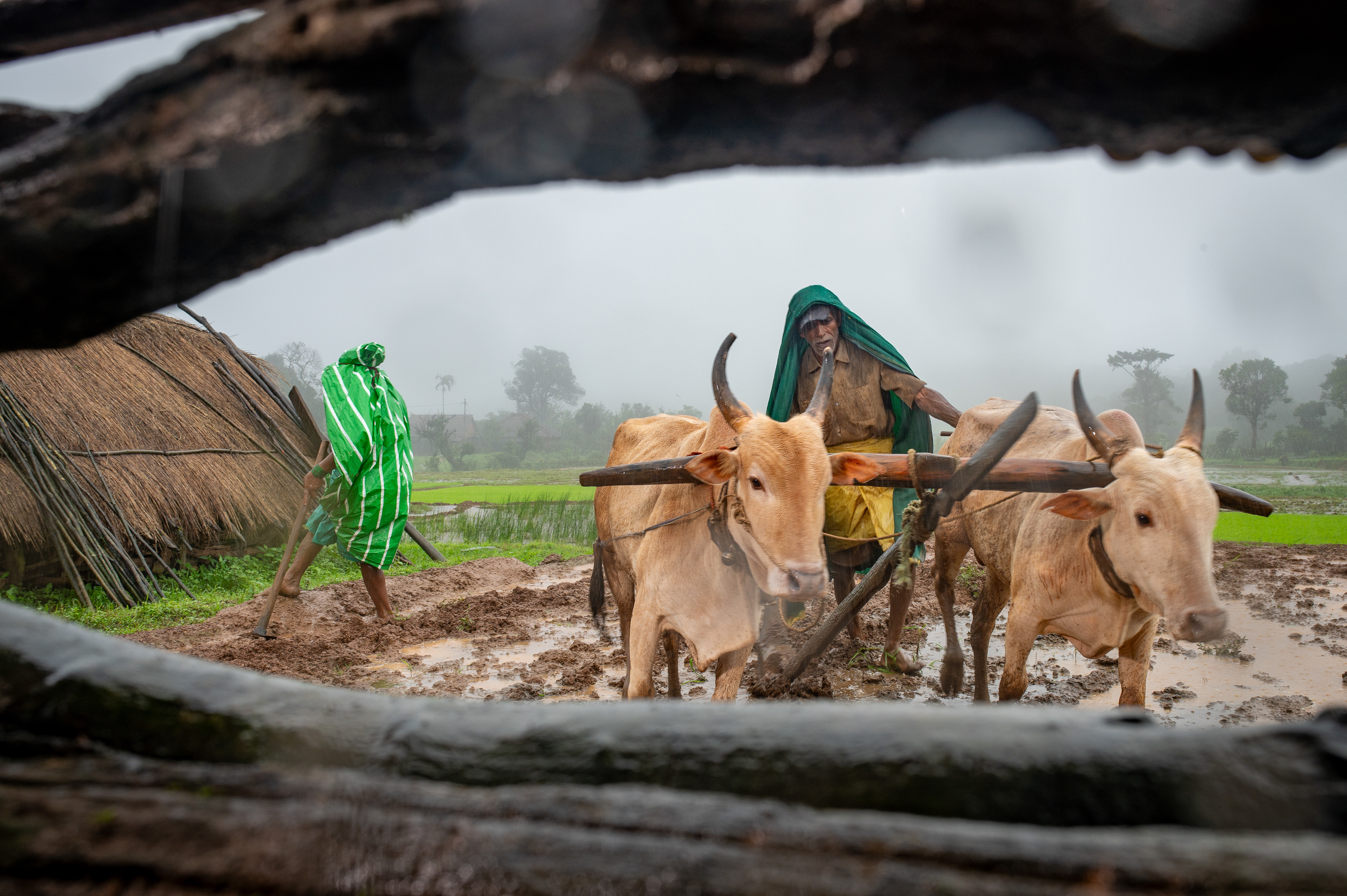
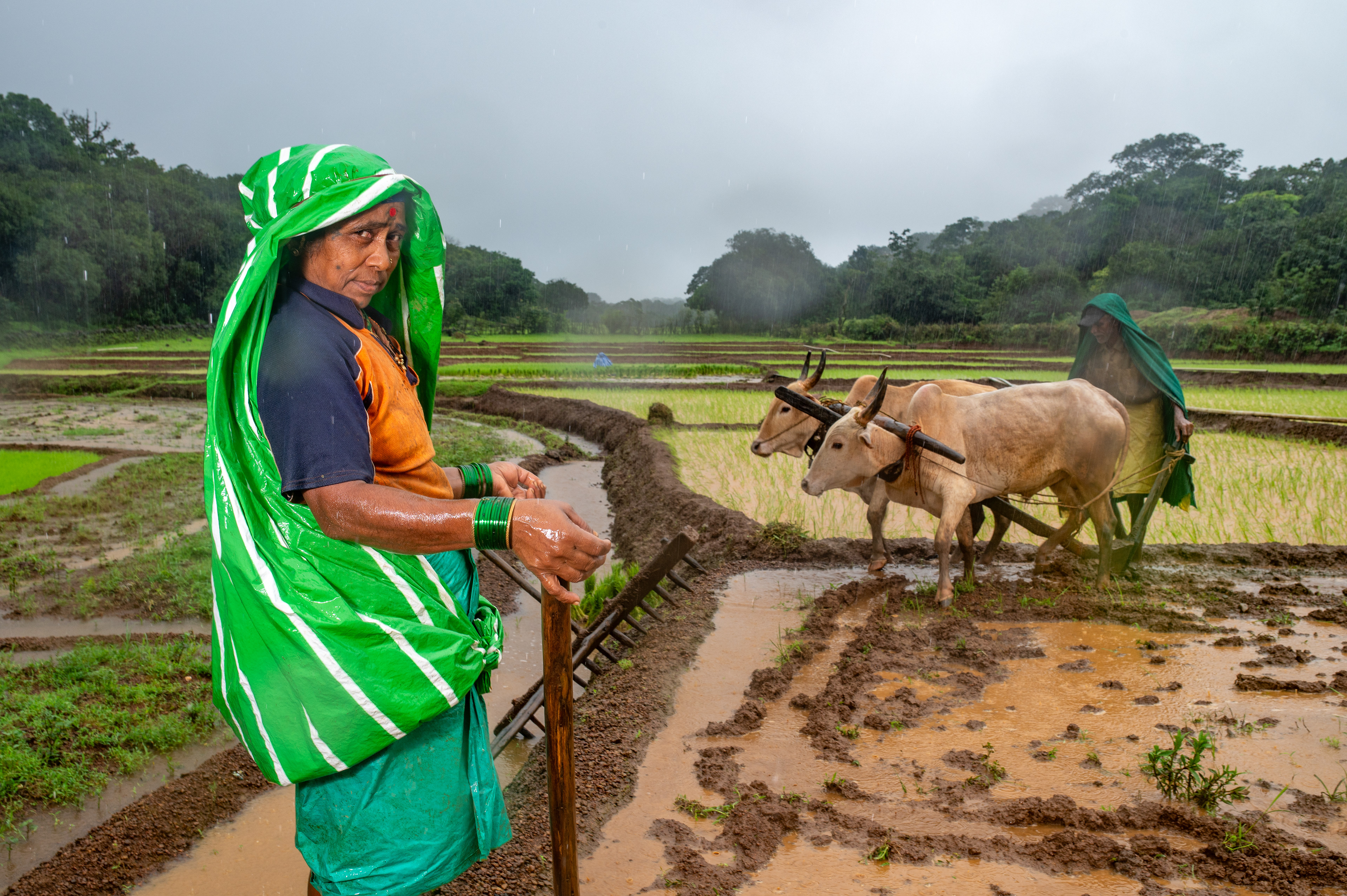
Soham Mama and Kamla Mami work on ploughing a patch of their field, using their ox.
Soham Mama, Krishna Mama’s younger brother, and his wife, Kamla Mami, prepared a plot of land by ploughing the field, while a bunch of other women transplanted young paddy splings onto already-ploughed land. I walked down to join the women, wading into the waterlogged field, where I instantly found myself shin-deep in mud, as the rain poured down on us. Initially taken aback, the women slowly warmed up to me as I spoke with them in Marathi, while I worked my hands simultaneously. I asked them to teach me how to plant these rice stalks in the ground, but the soil was so loose from all the water that you couldn’t even see it in the mucky waterlogging. They guided me patiently as I began to catch the hang of it.
As I caught the flow, I asked them about themselves, their lives, and their homes. Nandu Kaki, Harini Mami, and Dipa Kaku were all in their early sixties and had lived in Talewadi for over forty years each, similar to Aarti Kaku. “Tumhi ata gaav sodun challa, kasas vaatat ahe?” (How are you all feeling about leaving the village?) I asked the women. “Amhi sagli kashta sodun challo, ghar nahi,” (We are leaving the hardships, not the home,) Nandu Kaki said. Nandu Kaki’s response was powerful. It framed the “home” as something beyond a physical place. When asked whether they’d miss Talewadi, the women responded by saying, “Shevti ghar te gharach.” (After all, your home is your home.)
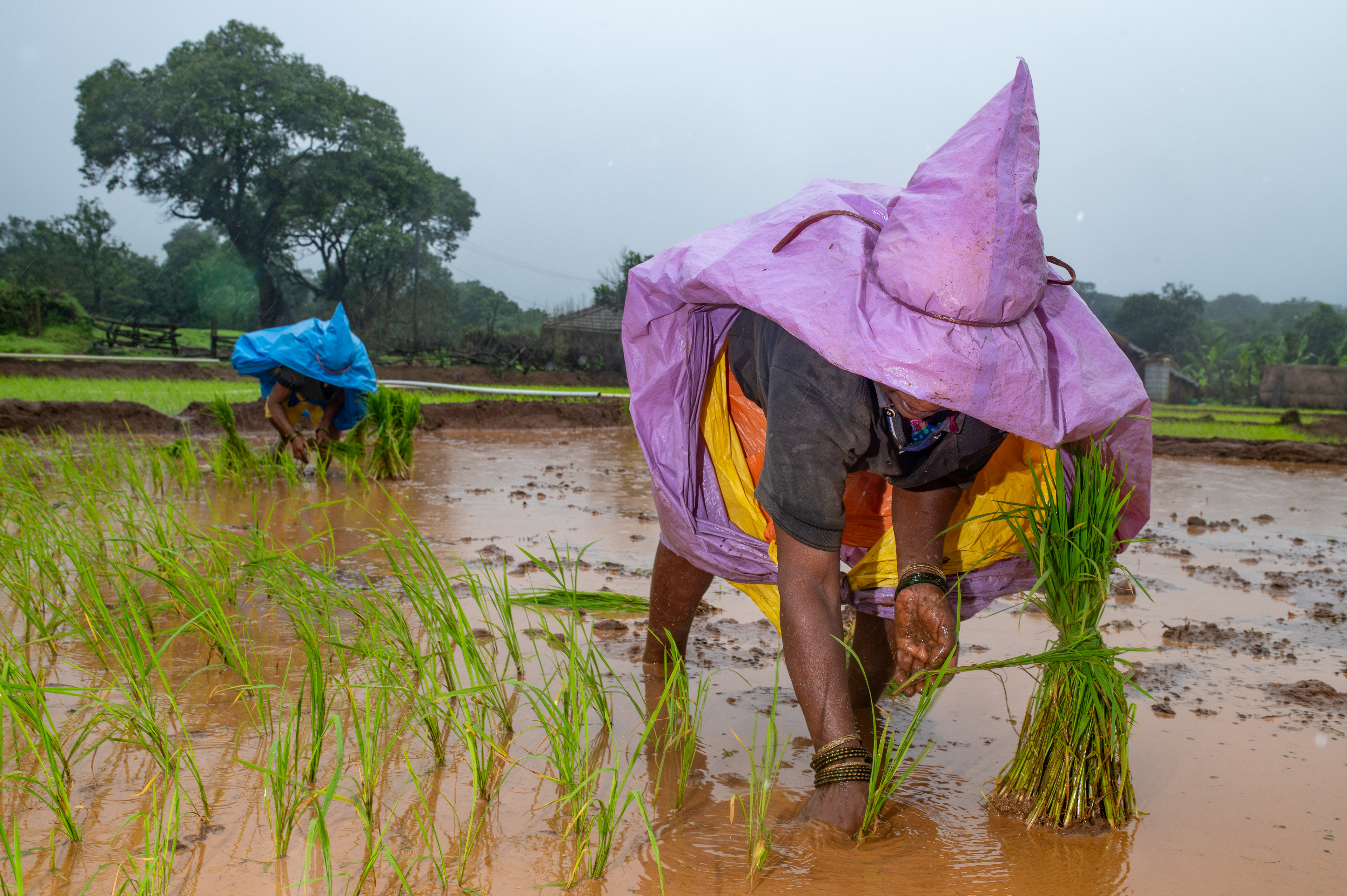
Nandu Kaki (right) and Harini Mami (left) transplant paddy stalks onto the ploughed and waterlogged field.
This distinction between the home and the physical place is central to the dwelling perspective championed by Tim Ingold (2000). Ingold argues that humans do not simply inhabit a pre-given world, but continuously constitute it through skilled, practical activities and embodied engagement with their environment. The kashta (hardships) are primarily tied to the physical site of Talewadi — the challenging climate, the inadequate infrastructure, and the constant human-wildlife conflict. Yet, the ghar (home) is not reducible to this troubled site. Instead, the home is the taskscape built over generations: the relational web of planting, cooking, coping with the rain, and knowing the forest's dangers. Nandu Kaki’s statement suggests that the essence of this home is portable, an enduring quality of place that can survive a shift in physical location. However, as I argue, the displacement fundamentally threatens to sever the villagers from the ecological materials and non-human relations and worlds that I have described until now. It is now important for us to discuss the Kashta that the villagers have been referring to.
Kashta (Hardships)
During one of the days in the field, I needed to update an application on my phone to enable the drone we were carrying to fly. Unfortunately, the APC had no internet coverage at all. I asked Mohan & Santosh where I would get any internet around the APC. Mohan told me, much to my annoyance, that there was only one place around the village where I would get internet, but the speed would still be pretty slow. Having no other choice, I had to try this. Santosh led me across the grassland behind the APC, close to the edge of the jungle. We came across a small shed made with wood, bamboo, and straw. It had a thatch roof and a little platform where you could sit. Maybe two people could sit here at a time. This was the only point where we could get a cellular network, even if we had to make only a phone call, Santosh told me. Since people often came here and the weather was unforgiving most of the time, they built this shed so that people could sit here for as long as they needed to. Santosh dropped me off here and left to return to a task at the APC. I had to work on downloading the update, but the slow internet speed meant I would be here for a little while, at least.
An elder woman in a poncho approached the shed while I waited for the update to complete, sitting inside. She looked to be annoyed by the cold and the rain, but marched to where I was with determination. This was Kusum Ajji, one of the village's oldest residents. For whatever reason, she couldn’t properly communicate with me. Maybe she was shy. But she was here to make a phone call to a relative in Khanapur; she wouldn’t tell me what she wanted to talk about. After attempting to place the call a couple of times, she was unsuccessful and visibly frustrated. I offered to help identify the problem, and she reluctantly agreed. Her phone had no signal. I offered to call the number on my phone. My phone did place the call, but Ajji’s relative did not answer the call. I told her that we would wait for them to call back, or call again if they didn’t call back in some time. A few minutes later, neither did they answer the call, nor did we receive a call back. Upset, Ajji walked back to her house.
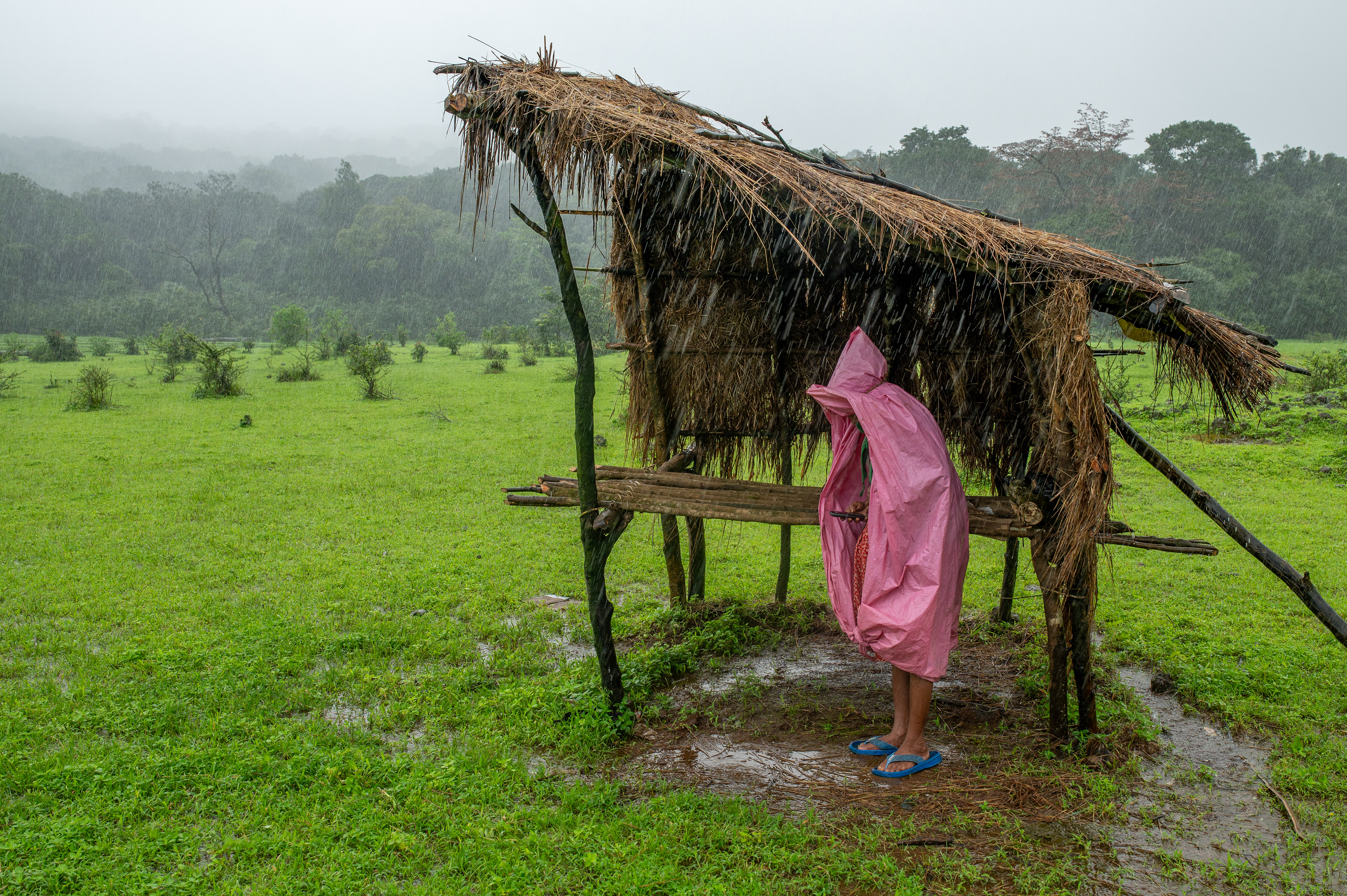
Kusum Ajji tries to place a phone call to her relative at the network shed.
It was sad watching her walk away dejected. But this was another reality of life in Talewadi. They didn’t have the luxury of waiting for someone to call back whenever they were able. If you are unable to talk with someone during your time at the shed, that's that. Communication with and access to the outside world are fairly limited here. On our final day, the departmental vehicle, which was supposed to pick us up from the village, was delayed by six hours due to scheduling delays and the vehicle getting stuck on the route. While it was inconvenient for us to have that delay, it did not have consequences nearly as severe as this situation in the village can sometimes have, especially during health and other emergencies.
As I mentioned in the section above, living with wild animals is a material fact of life within the sanctuary. One cannot walk around the village without getting leeches on them in the monsoons. The puddles on the roads are filled with skittering frogs and swamp eels. As mentioned above, the large predators are always looking for easy prey in the form of your cattle. One could romanticize these scenes and realities, but they come with a set of harsh realities that often blur the lines between life and death.
A couple of houses down from Aarti Kaku’s house, I met Balu Mama. Balu Mama also once had a fifteen-day-long visit to the hospital in Belgaum following an incident in which he was gored by a large Gaur while working in his fields. He recalls the experience as thinking that he was going to die. Thankfully, he survived the attack, but he still carries the physical remains of the incident in the form of scars on his waist.
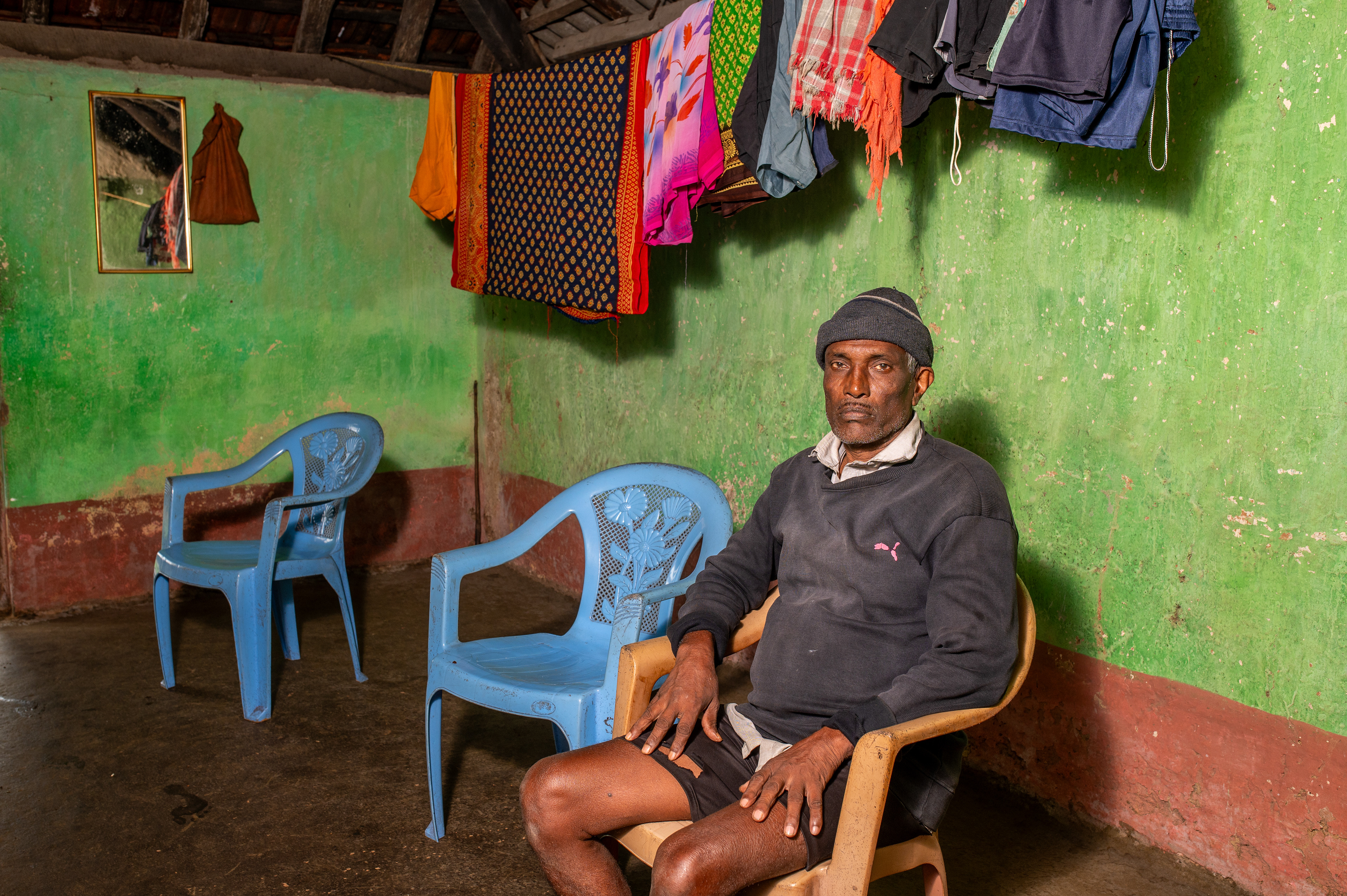
Balu Mama at his residence.
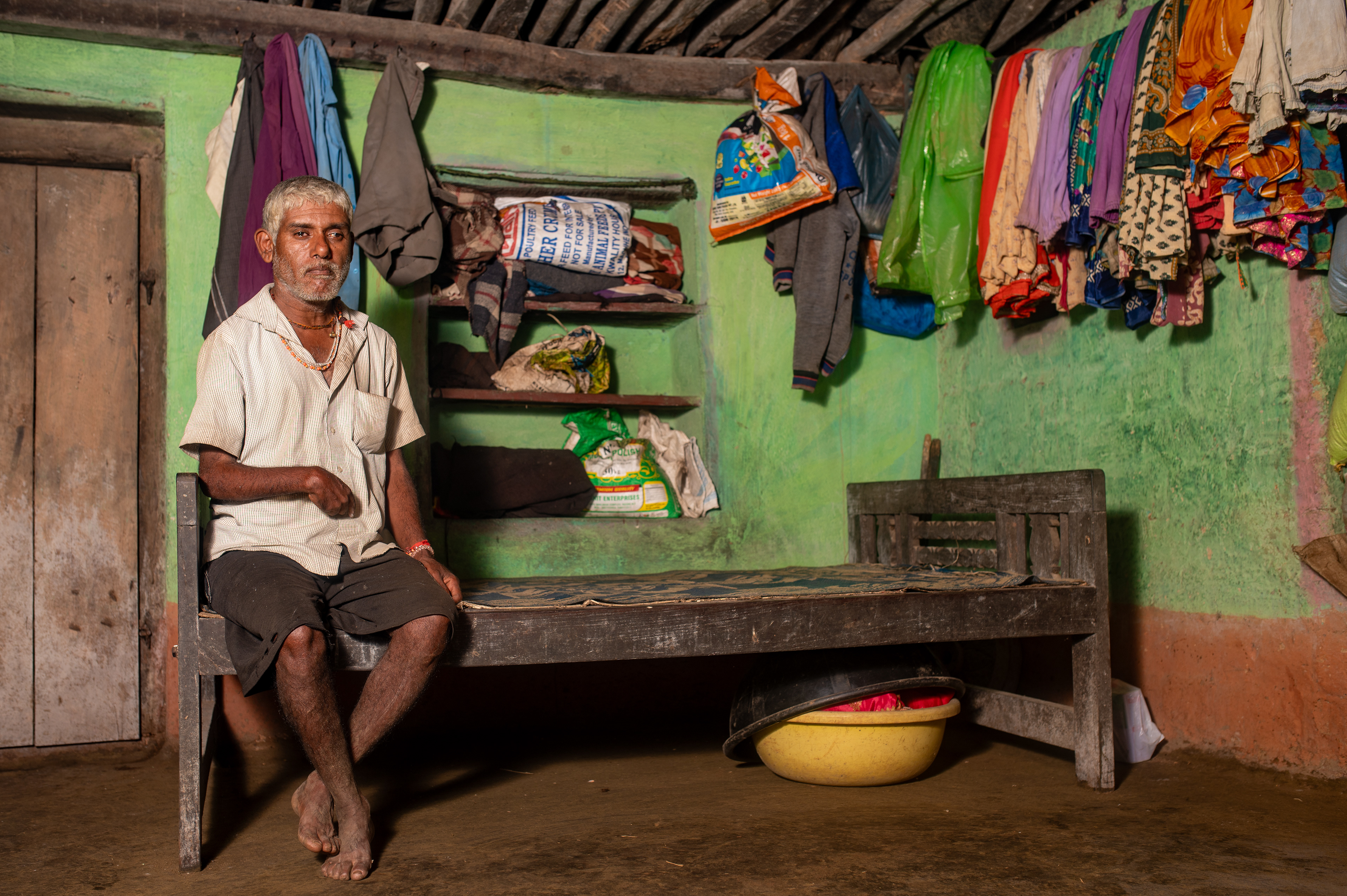
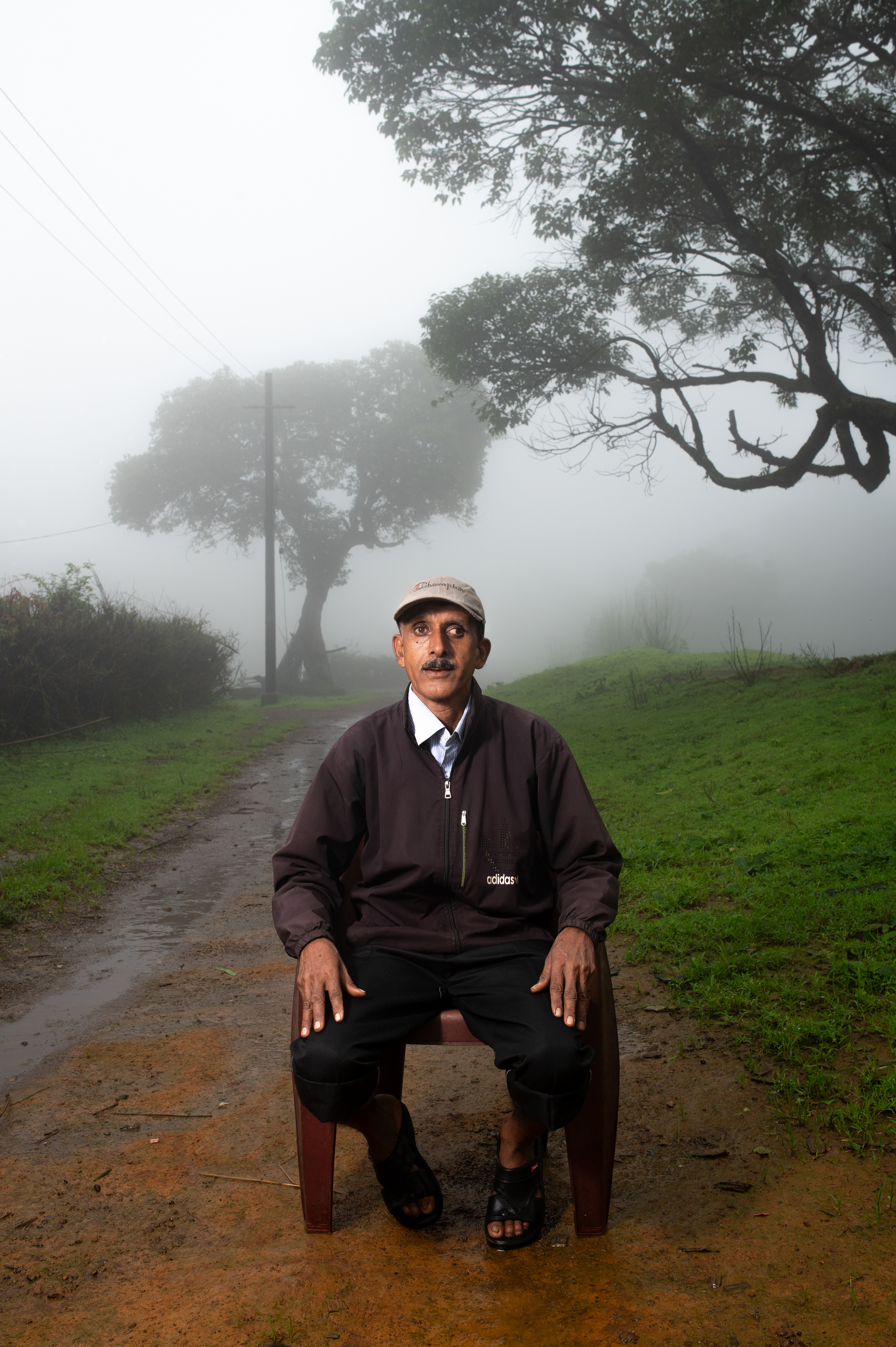
Achal met with Vinayak Kaka in the suburban center of Khanapur, located between Belgaum and Bhimgad, on a rainy afternoon, to discuss his experiences as a native of Talewadi. Vinayak Kaka had been attacked by the Indian Sloth Bear twice. Both times, he had to be rushed to the hospital in Belgaum, exposing the severe inability to access medical facilities in Talewadi. Vinayak Kaka also once narrowly escaped being eaten by a Tiger, he mentioned. “Talewadi madhe rahayla tar guarantee wagh, bibtya, aswal, kahi tari khaanarach,” (If you live in a place like Talewadi, a tiger, or a leopard, or a bear is guaranteed to kill and eat (someone),) he added. Although there have been no records of someone having been killed by these animals, Vinayak’s statement alludes to a general fear some of the villagers have. This makes a lot of sense given the fact that Vinayak had himself escaped death narrowly on multiple occasions.
Of all the people we spoke to, Vinayak Kaka was the most enthusiastic about making the move away from Talewadi to a more densely populated town. He mentioned that people used to hunt animals for subsistence and mine manganese for income until the increasing involvement of forest departments restricted these traditional livelihoods. He notes that he has been happier since the relocation talks began to finalize. This enthusiasm forces us to confront the central tension of this displacement: the villagers offer their consent, yet when the ecological and political conditions deny them the possibility of a secure life, this acceptance becomes less a choice and more an illusion of one. This seemingly paradoxical relief highlights the nature of the crisis: the relocation is ultimately an induced displacement fueled by the state's historical legacy of managing the forest, which has rendered life in the sanctuary unsustainable. When you add to this the fact that the department is currently developing tourist attractions, such as guided treks and safaris in the sanctuary, the relocation seems to serve an ulterior motive. It is also important to acknowledge that the Forest Department is the only formal employer in the village, thereby establishing an additional distinct power dynamic. However, I will note that such ulterior motives were also present on the opposite end: some families who hadn’t lived in the village for decades constructed the “dummy houses” I mentioned above to meet the criteria for owning a house and receive government compensation, showing how the compensation process is being gamed and that the relocation is, for some, purely a financial transaction, further undermining the idea of a sacred home that villagers such as Aarti Kaku speak of and revere.
Crucially, Vinayak’s enthusiastic view towards relocation, when compared to those of other villagers, demonstrates that the connection to home and perspectives are not a monolith: there is great variation in how people think and what they want. In general, the women seemed to have deeper connections to the place and were more resistant to the idea of relocation, as seen in Aarti Kaku, compared to men like Vinayak. Despite the aspirations of Vinayak and a few others like him, who had been pushing for relocation for nearly a decade, the relocation became a reality only in early 2025. The only thing that was keeping them from relocating earlier, Vinayak said, was a failure to reach an agreement with the forest department and the government.
These interactions in the village demonstrate how the relocation itself is a result of a myriad of actors coming together. The wild animals and the brutal weather of the rainforest act as the non-human and more-than-human agents that, while undeniably an integral part of the worlds and places made, exert their agency in a way that has pushed the villagers to consider moving away. The forest department, the government, the subsidiaries of, and the institutions around Project Tiger take the form of the human agents who make the choice an illusion. The anecdotes and discussion above demonstrate my argument that the "voluntary relocation" is an induced displacement resulting from the convergence of ecological kashta and the state's historical and political coercion.
Now that the “voluntary relocation” in the sanctuary has begun with Talewadi as the first village, likely to be the ‘model village’ for the other hamlets to follow, it would be interesting to follow the lives of the villagers as they continue to live their lives outside the rainforest. Having explored what home means here, I am curious about how this placemaking continues to manifest after the relocation. Importantly, how do the (soon-to-be ex-) residents of Talewadi envision their homes moving ahead? What do the villagers expect from the relocation? What are their aspirations for a life after Talewadi?
Pudhcha Jeevan (The life ahead)
In August 2024, the young District Collector of Belgaum, Mohammad Roshan, held a meeting with officials and villagers from the thirteen hamlets (The Hans India 2024). The DC urged a voluntary relocation, citing the difficulty of providing essential infrastructure inside the protected sanctuary. The villagers expressed concerns and requested alternative housing and land. Roshan promised to provide assistance in accordance with government guidelines. No alternatives have been provided to the villagers until now. The people of Talewadi have already begun the physical process of relocation, and the other villagers are to follow. With no specific place to go, everyone is left to fend for themselves with the compensation.
In December 2024, Karnataka’s Minister of Forests, Ecology, and the Environment, Ishwar Khandre, visited Talewadi to speak with the villagers. In May 2025, he directed officials to initiate the Gram Sabha process and ensure eligible families receive compensation as per the National Tiger Conservation Authority (NTCA) guidelines, which offer ₹15 lakh per voluntarily relocated family (All About Belgaum 2025). The very next day, he visited the village to personally hand over cheques worth ₹10 lakh to the families, announcing that the remaining amount would be disbursed after the relocation was completed.
When I interviewed the villagers, I always asked them about how they envisioned life to be once they were out of the sanctuary. “Talewadi sodun pudhchya jeevanasathi tumchi kay apeksha ahet?” (What are your aspirations for life after moving from Talewadi?) I’d ask. Aarti Kaku had a fairly simple vision: “Ata kay, mulan kadhe zaanar, anhi aaram karnar.” (Now what, I’ll just go live with my children and rest.) Many of the other villagers I spoke to had more specific answers to my question. We will be able to access better educational facilities for our children, have easier access to healthcare, and, more importantly, have access to better livelihood opportunities, many people echoed. The villagers told me it would be nice to have access to an uninterrupted cellular network and a well-maintained road network. Someone also mentioned being able to walk alone at night without worrying about being attacked by a bear. Overall, people aspired to have a more secure life in a safer, more urban place with access to basic amenities and financial opportunities. They all envisioned starting afresh, in a way.
These aspirations — which require money for urban housing, tuition, and business setup — make the final compensation amount strikingly inadequate. With these aspirations in mind, the compensation amount always astonished me. I thought 15 lakh per family, not per individual, was too low an amount to persuade people to relocate, let alone set them up for a decent life outside. I didn’t think much about this, given that this was an amount agreed upon by the villagers following long negotiations. However, as I had expected, an objection came about in October 2025. The villagers of Amagaon, the next village in line for relocation, resisted immediate relocation and set new conditions before agreeing to move. The primary contention was that the ₹15 lakh compensation was insufficient to build a new life, particularly as it didn't account for their agricultural land, houses, and communal institutions (TNN 2025). The results of this interaction are yet to be seen, and it remains unclear how any changes to the agreement would affect (or not!) the relocation terms of Talewadi.
Having presented a handful of the multitude of ways the people of Talewadi understand and connect with home, have made worlds, places, and multispecies possibilities for themselves and the non-humans around them, I feel confident in my argument that financial compensation is merely a transactional tool by the state to achieve its historically evident unidimensional goals. Evidenced by the recent developments in Amagaon, the financial compensation provided is insufficient to establish a basic, livable life, let alone support the other, more human facets of life, such as worldmaking and placemaking.
—
The myriad ways of being I have highlighted in this essay show us how places — and a home — are made in the rainforests of Bhimgad. Ultimately, the "voluntary relocation" of Talewadi is an induced displacement fueled by an illusion of choice, where the coercion of ecological precarity and state legacies of restricted livelihoods combine to force villagers out. The financial compensation offered for this move cannot adequately cover the true cost, which is the irrecoverable loss of a coherent, centuries-long worldmaking system woven into the very fabric of the forest ecosystem. However, the experience of exploring these facets in Talewadi was personally valuable not only as an academic subject, but in aiding my own understanding of what it means to have a home.
This project, along with the resulting scholarship and the proposed long-term ethnographic project exploring life after Talewadi, should serve as a frame of reference for other villages in Bhimgad and similar villages beyond. I present this ethnographic case study as an opportunity to recommend two implications: Firstly, documentation of such placemaking and ontologies of native and ‘forest-dwelling’ peoples will help build a body of work that can be used in legal and political arenas to contest such decisions with rooted and rich ethnographic evidence. Secondly, such work should encourage the concerned institutes to think about and invest effort not only in natural science research, but also social science research, which has the power to illuminate the inherently human side of such places.
During our interview with Aarti Kaku, I asked her if she’d like to visit Bhimgad again after she moves out. After all, she spent all sixty years of her life here; Mendil for the first twenty years, and Talewadi for the next forty. “Jevha paryanta majhe ghudge kaam kartil, sobat detil, tevha paryant dar varshi ek da tari pay tekun ach zanaar,” (Until my knees work, and can support me, I will make it a point to come touch my feet here at least once every year,) she responded with a glimmer of optimism, hope, and nostalgia in her eyes. Listening to her say this validated my exploration of the meaning of Home. Aarti Kaku said many noteworthy things in her interview, but two moments will always remain etched in my mind: her promise to return and "touch her feet" here at least once every year, and her resolve that wherever she ends up, she will make her Rangoli every morning.
Acknowledgements
Most importantly, I would like to acknowledge the kindness of the villagers of Talewadi, and the forest guards at the Talewadi Anti-Poaching Camp for aiding our stay in the village. This work is fundamentally indebted to the villagers, who not only opened their homes but also generously allowed us to witness and document the intricate fabric of their lives. I also express my gratitude to the senior officials of the Indian Forest Service & Karnataka Forest Department, who enabled us to spend time with the villagers. I choose not to reveal their names to avoid governmental complications. Many thanks also to all the employees of the Karnataka Forest Department in Bhimgad for their logistical assistance. Lastly, thanks to Achal C. for being an insightful field partner and for coordinating the permit procedure for this project.
References
All About Belgaum. "Relocation of Talewadi Residents in Bhimgaf Wildlife Sanctuary." All About Belgaum, May 16, 2025. Accessed December 8, 2025. https://allaboutbelgaum.com/news/relocation-of-talewadi-residents-in-bhimgaf-wildlife-sanctuary/.
Boas, Franz. The Mind of Primitive Man. New York: The Macmillan Company, 1911.
Butler, Judith. Precarious Life: The Powers of Mourning and Violence. New York: Verso, 2004.
Campbell, J. M. Gazetteer of the Bombay Presidency...: Belgaum. Vol. 21. Bombay: Printed at the Government Central Press, 1884.
Davidson, Judith. Sacred Rice an Ethnography of Identity, Environment, and Development in Rural West Africa. PhD diss., University of Washington, 2016.
Deccan Herald. "Amagaon is Now Cherrapunji of South." Deccan Herald, August 13, 2012. https://www.deccanherald.com/content/271493/amagaon-now-cherrapunji-south.html.
Gadgil, Madhav, and Ramachandra Guha. This Fissured Land: An Ecological History of India. Berkeley: University of California Press, 1993.
Geertz, Clifford. The Interpretation of Cultures: Selected Essays. New York: Basic Books, 1973.
Goodman, Nelson. Ways of Worldmaking. Indianapolis, IN: Hackett Publishing Company, 1978.
Govindrajan, Radhika. Animal Intimacies: Interspecies Relatedness in India's Central Himalayas. Chicago: The University of Chicago Press, 2018.
Guha, Ramachandra. "Radical American Environmentalism and Wilderness Preservation: A Third World Critique." In The Ethics of the Environment, 179–191. Abingdon: Routledge, 2017. https://doi.org/10.4324/9781315239897-12.
Ingold, Tim. The Perception of the Environment: Essays on Livelihood, Dwelling and Skill. London: Routledge, 2000.
Kalki, Yatin, and Mark Weiss. "Understanding the Food Habits of the Green Vine Snake (Ahaetulla nasuta): A Crowdsourced Approach." Herpetology Notes 13 (2020): 835–843.
Mauss, Marcel. The Gift: The Form and Reason for Exchange in Archaic Societies. Translated by W. D. Halls. London: Routledge, 1990.
The Hans India. "DC Urges Families to Relocate from Sanctuary." The Hans India, August 12, 2024. Accessed December 8, 2025. https://www.thehansindia.com/news/cities/bengaluru/dc-urges-families-to-relocate-from-sanctuary-898823.
TNN. "Amagaon Villagers Set Conditions for Relocation from Bhimgad Wildlife Sanctuary." The Times of India, October 27, 2025. https://timesofindia.indiatimes.com/city/hubballi/amagaon-villagers-set-conditions-for-relocation-from-bhimgad-wildlife-sanctuary/articleshow/124830956.cms.